Stablecoin trust center marketing: building architecture for confidence, compliance & adoption
This guide explains how a Trust Center architecture can transform stablecoin marketing. Learn why reserve transparency, zero-trust security, compliance by design, governance and modularity matter - and how to turn these pillars into user trust, activation and measurable growth.


The promise
Stablecoins promise digital dollars without volatility, yet recent market turbulence and emerging regulations reveal that trust cannot be claimed; it must be engineered. A Trust Center is more than a disclosure page - it's a product architecture that makes reserves, security, compliance, governance and user experience verifiable. When built well, a Trust Center becomes the foundation for a marketing strategy that translates technical assurance into user confidence, adoption and enterprise credibility. This article shows how to architect a Trust Center, why it matters now, how to apply it across the funnel and how to measure success.
The reality
A stablecoin Trust Center should not be a static webpage; it should be the public evidence layer of the product. It must prove that each token is backed one-to-one with high-quality assets, that the system is secured by zero-trust design, that compliance is embedded without unnecessary surveillance, that governance is clear and that the architecture is modular and auditable. When these pillars are translated into simple user promises, they build trust, adoption and revenue-aligned growth.
Summary table: Trust Center pillars & user promises
The Trust Center covers five interlocking pillars. Each pillar has a technical requirement and a user promise. This condensed table keeps the phrases short and scannable.
| Trust pillar | Technical essentials | Marketing translation |
|---|---|---|
| Reserve transparency | 1:1 liquid reserves; attestations | You can verify what backs your stablecoin |
| Zero-trust security | Least privilege; MFA; audits | Security is built into every layer |
| Compliance by design | KYC/KYB; AML; privacy proofs | Compliance and privacy can coexist |
| Governance & accountability | Decision rights; multi-party controls | Operators are accountable; controls are clear |
| Modular & interoperable design | Auditable modules; safe upgrades | Upgradeable yet predictable; chains have clear risks |
The problem: trust isn't a slogan
The real problem for stablecoin teams is not creating a flashy website; it's designing a product that survives redemption pressure, cyber-attacks and regulatory scrutiny.
Users ask simple questions - "Is this token really backed? Can I redeem it? Will I get frozen?" - which are product questions disguised as marketing questions.
When teams treat trust as a communications problem, they end up making claims like "fully backed" without evidence. When a de-pegging event or exploit happens, credibility evaporates.
Primary ICP: stablecoin issuers & crypto fintech leaders
This article speaks first to stablecoin product teams, growth marketers and compliance officers who are building or scaling fiat-backed stablecoins. It's equally relevant to wallets, exchanges, payment processors and fintech platforms deciding whether to integrate stablecoins or develop their own. The core pain: balancing regulatory compliance, user adoption and financial stability while standing out in a crowded market.
Why this matters now
Stablecoins have grown from a niche crypto tool to a foundational payment rail. Supply has reached roughly $238 billion as of August 2025. Policymakers across the U.S., EU, UAE and Hong Kong have enacted legislation requiring issuers to hold reserves on a 1:1 basis in high-quality liquid assets like cash, bank deposits and Treasuries. These rules highlight the importance of reserve transparency and restrict interest payments to prevent quasi-banking.
Recent analyses by the Federal Reserve note that during periods of financial stress, stablecoins may appear safer than bank deposits if reserves are transparent and viewed as less risky, but their liquidity advantage can be situational. This underscores the need for credible redemption processes and stress-testing. Meanwhile, the Financial Stability Board warns that poorly designed and unregulated stablecoins are prone to fragility, citing 2022 de-pegging events and highlighting risks related to data privacy, cyber-security and consumer protection. The FSB also notes that stablecoins are increasingly used for cross-border payments and remittances in emerging markets, where trust and regulatory oversight may be weaker.
Stablecoin growth and regulation create an opportunity and a mandate. Teams that build transparent, resilient trust architecture will differentiate; those that rely on slogans may find themselves unbanked, unregulated or unused.
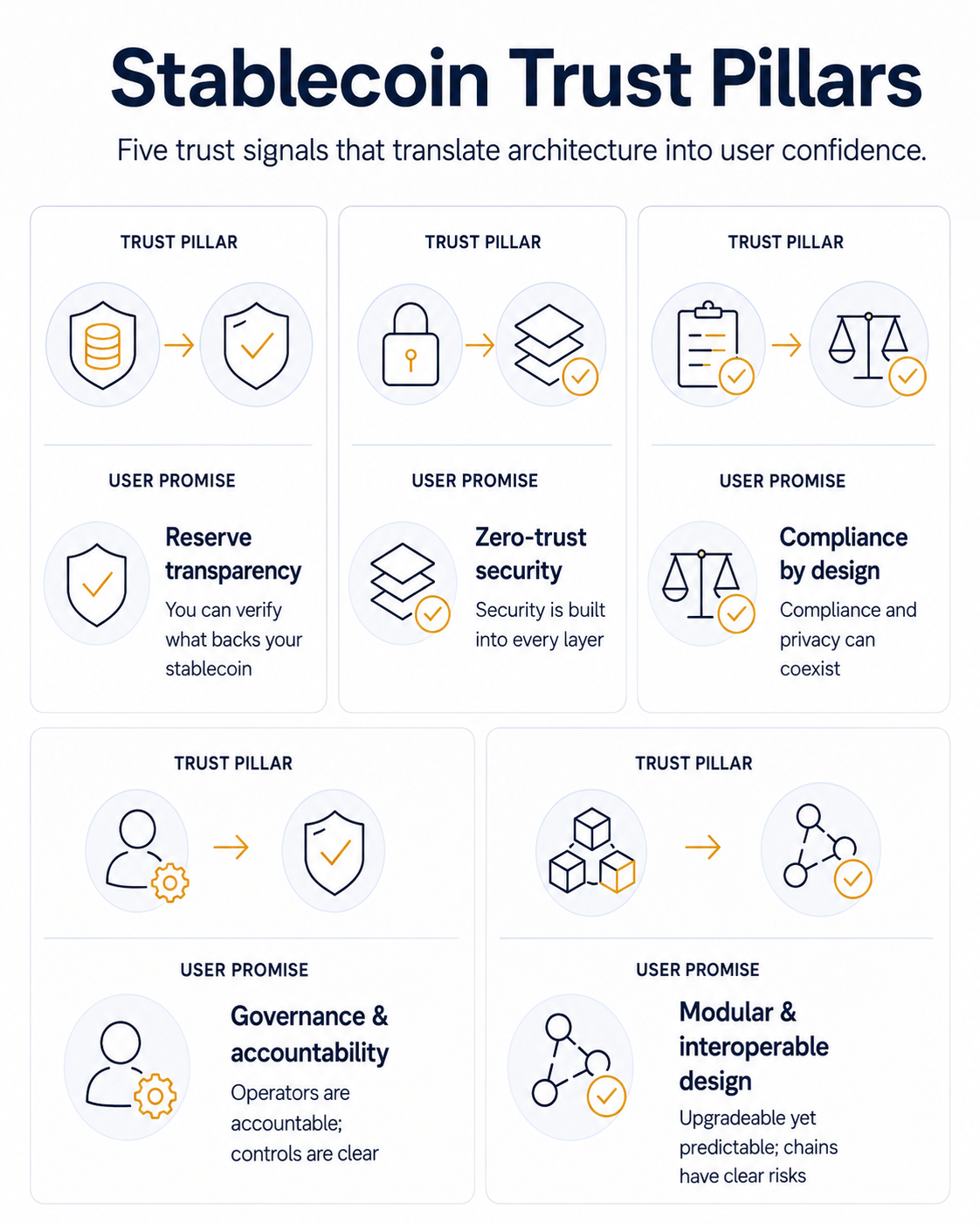
The trust center framework
The Trust Center framework consists of five pillars that convert product architecture into user confidence. Each pillar addresses a user question and a business outcome.
1. Reserve transparency: Can I redeem?
What it means: Issuers must hold high-quality, liquid reserves equal to all circulating tokens. They should publish independent attestations and explain where and how assets are held.
Why it matters: The FSB and new stablecoin laws emphasize that the collapse of certain stablecoins stemmed from inadequate reserves. Users and regulators now expect on-demand proof. During market stress, transparent reserves can make stablecoins appear safer than bank deposits.
How to apply: Build automated reserve monitoring and stress-testing. Publish regular reports with third-party auditors. Explain redemption processes, rights and limitations. Translate the technical design into a clear message: "This stablecoin is backed one-to-one by high-quality assets with independent verification."
2. Zero-trust security: Can I use it safely?
What it means: Assume nothing in your system is trusted by default. Employ least-privilege access, multi-factor authentication, hardware security modules and multi-signature controls. Audit smart contracts and monitor transactions in real time.
Why it matters: Stablecoin systems involve smart contracts, APIs, admin tools and human operators. A compromised key or contract can drain reserves or freeze users. The FSB highlights cyber-security and data-privacy risks as major weaknesses for unregulated stablecoins.
How to apply: Adopt a zero-trust architecture across smart contracts, custody infrastructure, admin interfaces and compliance systems. Use penetration testing and bug bounties. For the user, translate this into: "Access is segmented, monitored and controlled so that one incident doesn't compromise the whole."
3. Compliance by design: Can I use it legally and responsibly?
What it means: Embed KYC, KYB, AML and sanctions controls into transaction flows while protecting user data. Implement privacy-preserving proofs so users can prove eligibility without exposing unnecessary information.
Why it matters: New laws require issuers to collect and screen user information. At the same time, privacy and dignity remain core to crypto adoption. The FSB warns that financial integrity, consumer protection and data privacy are at risk without proper design.
How to apply: Use verifiable credentials for identity proofs. Implement tiered KYC to match risk levels. Explain what data is collected, why and how it's protected. Craft a message like: "Compliance and privacy are not enemies; our system verifies what matters and protects the rest."
4. Governance & accountability: Who controls it?
What it means: Define who can mint, burn, upgrade or pause contracts; who controls admin keys; what requires multi-party approval; and how emergencies are handled.
Why it matters: Regulation demands clear decision rights and escalation paths. Enterprise customers - exchanges, payment processors, treasury teams - want to know redemption rights and incident response.
How to apply: Publish governance policies and escalation procedures. Implement multi-signature and time-locked upgrades. Provide visibility into risk committees and board oversight. For marketing, frame this as: "This stablecoin is operated by accountable professionals under clear controls."
5. Modular & interoperable design: Will it evolve without breaking?
What it means: Build smart contracts as modules (minting, redemption, compliance, oracles, governance) with auditable upgrade paths. For multi-chain deployments, identify chain-specific risks and bridge designs.
Why it matters: Regulations and technologies change. A rigid contract could become non-compliant overnight. But upgradeability raises trust concerns: users need to know who can make changes and how.
How to apply: Document your upgrade process, governance approvals and audit results. Communicate differences between chains (security assumptions, liquidity, compliance tooling). The message: "Our architecture is modular and auditable; upgrades follow defined procedures with multi-party approval."
What teams usually get wrong
1. Treating trust as a marketing afterthought: Many teams build a stablecoin first and scramble to craft messaging later. Without underlying proof, slogans ring hollow and regulators remain unconvinced.
2. Hiding reserves behind legalese: Publishing a PDF once a quarter isn't transparency. Users want real-time assurance and easy-to-read dashboards.
3. Over-engineering compliance friction: Teams sometimes demand full identity verification before users can even explore the product. This kills adoption. Compliance can be layered in over time based on risk.
4. Ignoring governance until there's a crisis: When a contract is exploited or an oracle fails, no one knows who can act. Governance should be designed and published before launch.
5. Pretending every chain is the same: Cross-chain stablecoins that gloss over security differences risk brand damage when one network is exploited.
What to do instead (operational level):
1. Build the Trust Center early: Make the Trust Center a core product module, not a marketing add-on. Integrate live reserve data, audit links, incident reports and governance policies.
2. Automate proofs: Use on-chain attestations, API-accessible dashboards and third-party audits so proof updates are automatic and tamper-evident.
3. Simplify onboarding: Start with minimal identity checks for low-risk transfers and add more verification as transaction size or frequency grows. Explain the process clearly.
4. Segment access and controls: Use role-based access and multi-sig approvals across engineering, treasury, compliance and customer support.
5. Define upgrade governance: Publish a clear process for contract upgrades, including notice periods, approval thresholds and rollback plans.
6. Localize risk communication: For each supported chain, create a risk and fee summary so users understand differences.
7. Educate in context: Integrate tooltips, guides and how-to videos within the product, rather than relying on long blogs.
8. Measure trust engagement: Track visits to your Trust Center, time spent, downloads of reserve reports and feedback from enterprise prospects.
How to measure success
Trust architecture should translate into measurable outcomes. Useful metrics include:
- Activation: share of sign-ups that perform their first on-chain transaction. A trust center should increase activation by reducing fear.
- Redemption confidence: ratio of redemption requests to circulating supply during stress events. Clear reserves and redemption procedures should reduce panic.
- Time to first transaction: average duration from onboarding to first payment. Simplified compliance and education should shorten this.
- Trust Center engagement: number of visits, report downloads, and time spent on proof pages.
- Enterprise conversion: number of institutional partners integrating the stablecoin after reviewing governance and compliance documentation.
- Compliance objection reduction: decline in objections from legal and finance teams during sales calls.
- Net retention: rate of users sending more than one payment per week/month. Trust architecture should promote repeat usage.
- Qualified opportunities: inbound inquiries from wallets, exchanges or fintechs citing trust architecture as a reason for interest.
Nuance & counterarguments
Building a Trust Center does not guarantee adoption. Usefulness and incentives still matter. Users will not switch from existing payment tools unless the stablecoin offers tangible benefits such as: lower fees, faster settlement, or new functionality. Additionally, some crypto-native users may prefer fully decentralized, anonymous tokens; a trust-led approach may not appeal to them. Finally, regulations evolve: features that meet compliance today may require redesign tomorrow. Teams should invest in agility alongside transparency.
Commercial bridge
If you lead a stablecoin project, wallet platform, exchange or crypto fintech, the practical question is not only "How do we explain trust?" It's "How do we architect trust so deeply that adoption follows?" I work with teams to translate technical design into user proof, integrate compliance without killing growth, and build marketing systems that convert trust into activation, retention and revenue. Let's build a stablecoin trust architecture that survives contact with users, regulators, and market stress.
Building trust can scale
Trust isn't built in the footer. It's engineered across reserves, security, compliance, governance and modularity. A well-designed Trust Center turns these pillars into clear user promises and measurable business outcomes. Teams that adopt this architecture will stand out as credible, compliant and user-oriented in a rapidly evolving stablecoin landscape.
Frequently Asked Questions
What is a stablecoin Trust Center?
A Trust Center is a public evidence hub that explains how a stablecoin is backed, secured, governed, monitored and kept compliant. Unlike a static disclosure page, it should reflect the product's actual trust architecture.
Why does reserve transparency matter?
Transparent reserves and redemption processes build user confidence and satisfy regulatory demands. During financial stress, transparent reserves may make stablecoins appear safer than bank deposits. Lack of transparency contributed to past stablecoin collapses.
What does zero-trust security mean?
Zero-trust security treats no actor, internal or external, as inherently trustworthy. Every request must be authenticated, authorized and monitored. This minimizes the blast radius of incidents and protects reserves.
How can compliance and privacy coexist?
A compliance-by-design system embeds KYC, AML and sanctions controls into transactions while limiting unnecessary data exposure. Techniques such as verifiable credentials and zero-knowledge proofs allow users to prove eligibility without revealing all personal information.
Who controls a stablecoin's governance?
Strong governance defines who can mint, burn, upgrade or pause the stablecoin's smart contracts. Multi-party approvals, clear escalation paths and published policies ensure accountability.
Why build a modular contract design?
Regulations, security threats and user needs evolve. A modular smart-contract architecture allows for upgrades and chain-specific risk management without rewriting the entire system.
How does a Trust Center support marketing?
It answers core user questions: Can I verify it? Can I use it safely? Can I use it legally? Is it worth switching? It also provides proof, such as reports, audits and policies, that can reduce fear, speed up activation and support enterprise due diligence.
What metrics should we track?
Beyond impressions, track activation rate, redemption confidence, time to first transaction, Trust Center engagement, enterprise conversion, compliance objection reduction and net retention. These indicate whether trust architecture is driving business outcomes.
Author note
Stefan Furcoi is a senior Web3/Crypto growth marketer focused on wallets, exchanges, protocols, and crypto fintech. His work connects positioning, trust, compliant education, activation, retention, content authority, and measurable business outcomes.
Disclaimer: The content of this article is provided for general informational purposes only and does not constitute financial, investment, legal or tax advice. StefanFurcoi.com makes no representations or warranties regarding the accuracy or completeness of the information, and it should not be relied upon without consulting qualified professionals. Any views expressed are subject to change and do not reflect any commitment to update the information. You are solely responsible for your decisions and should conduct your own research before acting on any information.