Stablecoin marketing strategy: when to say crypto and when to sell payment outcomes
Stablecoin marketing works best when teams lead with payment outcomes, trust, activation, and proof. Learn when to use crypto-first messaging and when to position stablecoins as payment infrastructure.


By Stefan Furcoi
The reality of stablecoin marketing
Stablecoin marketing has a simple but expensive positioning problem.
Many teams lead with “crypto payments” when the buyer does not primarily want crypto. The buyer wants faster settlement, lower payment friction, clearer records, better recipient experiences, and fewer operational delays.
That does not mean stablecoin companies should hide the technology. It means they should sequence the message properly and without sounding like a copy of another copy from yet, another blockchain. The marketers that have been long enough in crypto know what that means and how some projects look unauthentic, especially when the only thing that's marketed is the blockchain features and nothing specific or market worthy.
The practical rule is this: market stablecoins as crypto when crypto is the reason the product is better. Market them as payment infrastructure when crypto is the rail creating a better business outcome.
For mainstream merchants, marketplaces, CFOs, finance teams, payroll platforms, and compliance-sensitive fintech buyers, stablecoin messaging usually works better when it starts with outcomes and not with the product itself. These buyers are not usually waking up thinking about wallets, chains, token standards, or on-chain settlement. They are thinking about delayed payments, frustrated recipients, reconciliation work, support tickets, and operational risk.
For crypto-native buyers, the equation changes. Wallets, exchanges, DeFi protocols, Web3 apps, developers, and on-chain infrastructure teams may care deeply about wallet compatibility, settlement speed, programmability, liquidity, and network support. In those cases, crypto-first messaging can increase credibility because the technical layer is part of the value.
The senior growth challenge is not choosing one message forever. The challenge is knowing which message fits the buyer, the use case, the risk profile, and the activation path.
When to say crypto vs. when to sell outcomes
A strong stablecoin marketing strategy should lead with the buyer’s desired payment outcome, then support that outcome with trust, operational proof, and technical explanation.
For mainstream business buyers, stablecoins should usually be positioned as faster, clearer, and more flexible payment infrastructure before the crypto layer is explained. For crypto-native buyers on the other hand, stablecoins can be marketed as crypto when on-chain settlement, wallet compatibility, programmability, or when DeFi integration is the reason the product is valuable.
To make this clear, know that the wrong move is not saying “crypto.” The wrong move is saying it before the buyer has a reason to care enough.
The problem: stablecoin teams often sell the rail before proving the outcome
Stablecoin teams often explain the technology before they earn the buyer’s attention and trust.
They talk about chains, wallets, APIs, token standards, settlement infrastructure, gas fees, yield and on-chain liquidity. Those details may be important, but they are rarely the first reason a mainstream payment buyer cares.
A marketplace operator cares about payout completion. A finance lead cares about reconciliation. A contractor platform cares about recipient experience. A merchant cares about settlement timing and cost. A compliance team cares about risk, screening, jurisdiction availability, and auditability.
When the first message is “crypto payments,” the buyer may hear complexity before value.
That is the operating problem. The product may be solving a real payment pain, but the message introduces the most anxiety-producing part of the system before the buyer understands the business improvement.
This is where stablecoin marketing needs more discipline. The technology should not disappear. But it should arrive at the right moment.
The better sequence is:
Business outcome → operational proof → technical explanation. (not the opposite)
This sequence above, gives the buyer a reason to keep reading, book a demo, ask a better question, or approve a pilot.
The default example: marketplace seller payouts
Marketplace seller payouts are a useful example because the buyer’s pain is easy to understand.
A marketplace operator usually does not wake up thinking, “I need blockchain settlement.”
The operator thinks, "How to reduce T+1" Or, “My sellers are waiting too long to get paid.” Or, “My payout costs are too high.” Or, “My support team keeps answering payment-status questions.” Or, “My finance team needs clearer records.” Or, “My international sellers want reliable access to USD-denominated value.”
That is the real wedge.
The stablecoin layer may help solve the problem, but the buyer does not need the technical thesis first. The buyer needs to understand the operational improvement.
A weak message says:
“Crypto-native payment rails for the future of Web3 commerce.”
That might work for a Web3-native marketplace. It will probably create friction for a mainstream marketplace that cares about seller satisfaction, payout speed, reconciliation, and risk reduction.
A stronger message says:
“Help global sellers get paid faster with USD-denominated settlement, clearer payout records, and recipient onboarding support.”
That message does not hide the stablecoin layer. It simply starts where the buyer already feels the pain.
Why this matters now
Stablecoin marketing deserves a more insightful GTM conversation because the category is no longer only a crypto trading tool.
Cross-border payments remain an obvious pain point. World Bank remittance data continues to show that sending money globally is not cheap, which keeps cost, access, and speed commercially relevant. BIS also frames the G20 cross-border payments programme around speed, transparency, access, and cost. In other words, stablecoin products are not entering a market where the pain is imaginary. They are entering a market where the pain is already institutionally recognized.
At the same time, stablecoins are increasingly being discussed as payment infrastructure, not only as crypto market plumbing. McKinsey has described stablecoins and tokenized cash in the context of next-generation payments, including cross-border payments, remittances, trading and capital market settlement, treasury, and cash management.
In my opinion, there is also a visibility shift. Public on-chain data makes parts of stablecoin movement easier to observe than many traditional payment flows. Visa’s Onchain Analytics Dashboard exists to help users understand how fiat-backed stablecoins move across public blockchain networks globally.
These signals do not mean every stablecoin product will win. They mean the category is mature enough that marketing needs to move beyond broad crypto narratives and toward specific adoption systems.
The winning teams will not simply say, “Stablecoins are faster.”
They will prove where they are faster, for whom, under which workflow, with what compliance process, and with what measurable business result.
The positioning rule: lead with the buyer’s confidence trigger
The most useful positioning rule is not “always say crypto” or “never say crypto.”
The better rule in my experience is:
If crypto increases buyer confidence, lead with crypto. If crypto increases buyer anxiety, lead with the payment outcome first.
That one decision prevents two common mistakes.
The first mistake is over-crypto positioning. This happens when a mainstream buyer sees “crypto payments” and immediately thinks about volatility, scams, custody risk, regulatory uncertainty, irreversible mistakes, or technical complexity.
The second mistake is over-sanitized positioning. This happens when a crypto-native buyer needs technical specificity, but the marketing hides the on-chain advantage behind vague fintech language.
Both mistakes weaken conversion because both misunderstand the buyer’s trust trigger.
Bonus (a third mistake) is treating maturing users like permanent beginners.
Stablecoin users do not stay in the same stage of the customer journey forever.
A user who enters the funnel as non-technical may begin with simple questions: What is a stablecoin? How do I receive it? Is it safe? At that stage, beginner education, onboarding guidance, and trust-building content matter most.
But after activation, the user’s needs obviously change.
Once someone has completed a first transaction, received a payout, used a stablecoin balance, or interacted with the product more than once, they often move from basic awareness into deeper evaluation. They may start asking more advanced questions about custody, reserves, supported networks, settlement flow, redemption options, risk controls, fees, compliance processes, and how the project actually handles digital assets.
That is a different lifecycle stage.
The mistake is continuing to treat that user as if they are still at the top of the funnel.
Good stablecoin marketing should evolve with the customer journey. Early-stage users need clarity and confidence. Activated users need transparency, control, proof, and deeper product education. Retained users may need advanced documentation, trust-center content, account-level reporting, comparison guides, and product updates that help them feel informed rather than talked down to.
This is where lifecycle marketing matters. The goal is to progressively disclose more sophisticated information as user trust, product familiarity, and intent increase.
A strong stablecoin growth system should map content to user maturity:
awareness → onboarding → activation → trust deepening → repeat usage → expansion.
If the content strategy stops at beginner education, the product may win first-time curiosity but lose maturing users who now need more specific answers before increasing usage, moving larger amounts, inviting teams, or adopting the product as part of a real workflow.
A CFO may need operational clarity before technical depth. A developer may need documentation before a business case. A marketplace operator may need recipient onboarding proof before blockchain details. A DeFi protocol may need liquidity and composability before a polished brand story.
The same product can require different entry points depending on who is reading.
That is not inconsistency. That is strategy.
The three-layer message map
A practical stablecoin marketing strategy needs a message map that sales, marketing, product, compliance, and customer success can all use.
The three layers are business outcome, operational proof, and technical explanation.
The business outcome is the headline layer. It answers the buyer’s first question: “Why should I care?”
For a marketplace, that might be faster seller payouts. For a payroll platform, it might be more reliable contractor payments. For a fintech product, it might be a smoother cross-border payment option. For a finance team, it might be clearer records and better payment visibility.
The operational proof layer explains why the claim is credible. This is where the buyer sees settlement timing, transaction records, recipient onboarding, fee clarity, support process, approval workflows, compliance controls, and pilot results. This layer matters because payment buyers are cautious. They do not only want a better story. They want to know what happens when money actually moves.
The technical explanation layer explains what powers the product. This is where stablecoins, supported chains, custody model, API endpoints, wallet flows, settlement mechanics, fiat on/off ramps, and security standards belong.
The problem is that many teams reverse the order. They open with the technical layer, then wonder why mainstream buyers hesitate.
For mainstream buyers, lead with business value. For technical buyers, lead with infrastructure clarity. For crypto-native buyers, lead with the on-chain advantage. For regulated buyers, lead with trust.
The message should not be one-size-fits-all. It should be sequenced around what the buyer needs to believe before taking the next step or it could be a mix of several layers as well.
When stablecoins should not be marketed as crypto first
Stablecoins should not be marketed as crypto first when the buyer is mainly trying to improve a payment workflow.
This often applies to mainstream merchants, marketplace operators outside Web3, CFOs, finance teams, payroll platforms, creator platforms, remittance products, and traditional fintech teams.
For these audiences, “crypto” can feel like a risk label. It may trigger questions before it creates interest.
A marketplace does not need to be convinced that blockchain exists. It needs to believe sellers can be paid more reliably. A payroll company does not need a lecture on tokenized cash. It needs confidence that contractor payouts can happen with less friction and clearer records. A finance team does not want a vision deck. It wants controls, reporting, and a process it can explain internally.
Better language for these buyers includes:
“Stablecoin-enabled settlement.”
“Digital-dollar payments.”
“Faster global payouts.”
“Modern cross-border payment infrastructure.”
“USD-denominated payment rails.”
“24/7 settlement infrastructure.”
“Clearer payout records.”
“Recipient-supported global payouts.”
The point is not to hide material information. The point is to make business value obvious before explaining the crypto infrastructure.
A transparent message might sound like this:
“The product uses stablecoin settlement infrastructure to help businesses move USD-denominated value faster, with clearer transaction records and recipient support where available.”
That is more useful than:
“We enable crypto payments for global commerce.”
The first statement gives the buyer a reason to continue. The second may create concerns before it creates interest.
When stablecoins should be marketed as crypto
Crypto-first messaging is not always wrong. In some markets, it is exactly right.
Stablecoins should be marketed as crypto when the audience already understands and values the crypto layer. That includes wallets, exchanges, DeFi protocols, Web3 marketplaces, on-chain games, DAOs, protocol teams, developers, and crypto-native infrastructure companies.
These buyers may care about wallet compatibility, liquidity, chain support, self-custody, smart contract logic, composability, and settlement speed. In that context, hiding the crypto layer can make the company look vague.
A wallet team wants to know what assets and networks are supported. An exchange wants to understand settlement reliability and custody implications. A DeFi protocol wants liquidity, composability, and technical documentation. A developer wants integration clarity.
For these buyers, crypto is not the obstacle. Crypto is the product advantage.
A strong crypto-native message might say:
“Stablecoin rails for wallets, exchanges, and crypto-native apps that need reliable on-chain dollar movement.”
That message works because it speaks both languages. It is technical enough to be credible and outcome-oriented enough to stay commercially relevant.
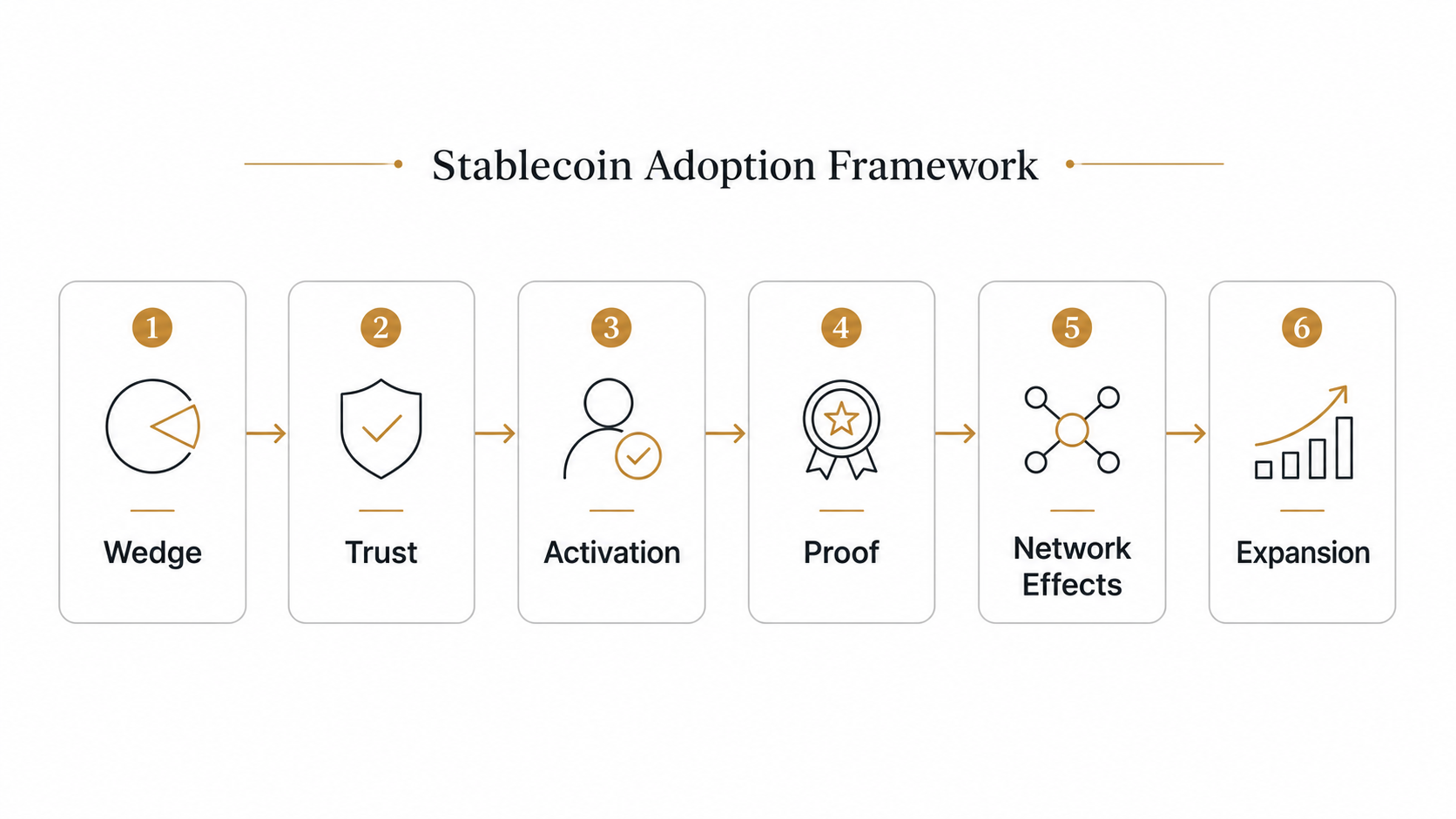
The stablecoin adoption system
Stablecoin marketing should not be built as a broad awareness campaign first.
It should be built as an adoption system.
The system has been around for a while and has six stages that are still relevant:
Wedge → Trust → Activation → Proof → Network Effects → Expansion.
In my opinion, this is the main framework because it turns positioning into a practical go-to-market sequence.
The wedge is the painful use case. Without a wedge, the message becomes too broad. “Stablecoin payments” is not specific enough. “Help marketplaces pay international sellers faster with clearer records” is sharper because the buyer, pain, and workflow are visible.
Trust is the risk-reduction layer. Stablecoin adoption requires buyers to believe the product is not only useful, but controlled. That means the funnel needs clear answers about supported stablecoins, custody model, compliance process, jurisdiction availability, fees, failed-payment handling, recipient onboarding, and support.
Activation is the first meaningful use of the product. In stablecoin payments, this is rarely just signup. It is usually the first completed payout, the first settled invoice, the first merchant settlement, the first recipient successfully onboarded, or the first cash-out completed where supported.
Proof is what turns a pilot into sales evidence. A pilot that only shows “we tested it” is weak. A pilot that shows faster settlement, fewer support tickets, cleaner reconciliation, lower failed-payment rates, or repeat usage becomes commercially useful.
Network effects matter because payments are rarely one-sided. A sender may like the product, but adoption can stall if recipients are confused, unsupported, or unable to use the funds. For marketplace payouts, both the marketplace and the seller need a trusted experience.
Expansion should come after repeat usage. Stablecoin teams can be tempted to pursue every corridor, market, or use case at once. That usually creates noise. The better path is to win one painful workflow deeply enough that the next expansion is evidence-based.
This is how stablecoin marketing becomes more than copywriting. It becomes a system for moving buyers from skepticism to confidence, from confidence to first transaction, and from first transaction to repeat usage.
What teams usually get wrong
Most stablecoin marketing mistakes are not caused by bad writing. They are caused by poor sequencing.
The team has a real product, but the message starts in the wrong place.
One common mistake is leading with technical language too early. A technical buyer may need that detail, but a mainstream buyer needs the business case first.
Another mistake is treating trust as a late-stage objection. In crypto fintech, trust is not a procurement detail. It is part of the product experience. If buyers have to chase basic answers about custody, fees, supported jurisdictions, screening, failed payments, or recipient onboarding, the funnel is already leaking.
A third mistake is using the same message for every buyer. A DeFi protocol, a marketplace operator, a payroll platform, and a CFO may all touch stablecoin infrastructure, but they do not buy for the same reason. One cares about composability. One cares about seller payouts. One cares about contractor reliability. One cares about finance controls.
The final mistake is measuring attention instead of adoption. Impressions, clicks, and signups can help diagnose interest, but they are not the final proof. A stablecoin GTM system needs to measure whether users complete the first meaningful transaction, repeat the behavior, and create evidence that sales can reuse.
That is the difference between content activity and growth infrastructure.
What to do instead
The better approach starts with a narrower question:
Where does the buyer already feel payment pain?
For a marketplace, the pain may be delayed seller payouts. For a payroll platform, it may be international contractor reliability. For a fintech dapp, it may be user access in markets where traditional rails are slow or expensive. For a crypto-native platform, it may be on-chain dollar movement, liquidity, or treasury operations.
Once the painful workflow is clear, the team can build the message around the buyer’s desired outcome. The stablecoin layer should then be introduced as the mechanism that supports the result.
That means the landing page should not only say what the technology is. It should show what the buyer gets, what the recipient experiences, what finance can export, what compliance can review, and what happens if the transaction fails.
The sales deck should not only explain the rails. It should show the before-and-after workflow.
The Trust Center should not be a decorative footer. It should answer the questions that delay approval.
The pilot should not be vague. It should be designed to create proof.
For marketplace seller payouts, the pilot could be narrow: one payout batch, one seller segment, one corridor, one baseline comparison, and one hero metric. That is enough to learn. It is also specific enough to create evidence.
Stablecoin marketing becomes stronger when the team stops trying to prove the entire category and starts proving one workflow.
How to measure stablecoin marketing success
Stablecoin marketing should be measured by movement through the adoption system.
The first serious measurement question is not whether people clicked the campaign. It is whether the buyer moved closer to trust, activation, repeat usage, or revenue.
A useful measurement system should track trust signals, activation signals, proof signals, retention signals, and commercial signals.
Trust signals include Trust Center engagement, compliance FAQ views, risk objections raised in sales calls, and buyer questions that disappear because the content already answered them.
Activation signals include first successful payout, time to first transaction, recipient onboarding completion, and first usable finance record.
Proof signals include settlement time reduction, failed-payment rate, support tickets per payout, reconciliation time, and recipient confirmation.
Retention signals include second transaction rate, repeat payment volume, active senders, active receivers, and expansion into adjacent workflows.
Commercial signals include demo-to-pilot conversion, pilot-to-paid conversion, sales-cycle velocity, qualified organic traffic, AI/search referrals, profile visits, and founder or recruiter inbound.
The weakest marketing systems stop at attention.
The strongest systems connect attention to trust, trust to activation, activation to proof, and proof to paid opportunity.
Outcome-first does not mean hiding crypto
This article is not arguing that stablecoin companies should hide what they are.
That would damage trust.
The point is sequencing.
For mainstream buyers, explain the payment problem first, the business outcome second, the operational proof third, and the stablecoin mechanism fourth.
For crypto-native buyers, technical specificity may need to appear much earlier.
A wallet team wants to know supported chains. A DeFi protocol wants to know liquidity and composability. An exchange wants to understand settlement reliability, custody model, compliance process, and asset support. A developer wants documentation. A CFO wants records. A compliance team wants controls.
Good stablecoin marketing does not remove complexity.
It places complexity where the right buyer expects it.
The senior marketing lesson
Stablecoin adoption is not won by choosing between “crypto” and “not crypto” as a permanent identity.
It is won by knowing when each frame creates trust.
For mainstream business buyers, stablecoins usually need outcome-first positioning. For technical infrastructure buyers, they need infrastructure-first positioning. For regulated buyers, they need trust-first positioning. For crypto-native buyers, they often need crypto-first positioning.
The marketer’s job is to map the buyer’s risk, motivation, and activation path.
That is where stablecoin marketing becomes more strategic than messaging.
It becomes market design.
Commercial bridge
For wallets, exchanges, payment startups, crypto fintech teams, and stablecoin infrastructure companies, the practical question is not only:
“Should we mention crypto?”
The better question is:
“Where does crypto create trust, where does it create friction, and how should the funnel adapt to that reality?”
A stablecoin GTM system should clarify the buyer, the payment problem, the proof needed before conversion, the trust assets that reduce risk, the activation event that proves value, the recipient experience that supports repeat usage, and the pilot data that can become sales proof.
Those questions connect marketing to revenue, retention, and product adoption.
That is the work senior Web3/Crypto growth marketing should do.
The takeaway
The winning approach is to start with one painful payment workflow, lead with the buyer’s desired outcome, build trust before asking for conversion, use the first successful transaction as the activation event, turn every pilot into proof, onboard both sides of the payment flow, and scale only after repeat usage.
- Use crypto-first messaging when the buyer already understands and values crypto.
- Use outcome-first messaging when the buyer mainly cares about business results.
- Use infrastructure-first messaging when the buyer is technical.
- Use trust-first messaging when the buyer is regulated, enterprise, or compliance-sensitive.
The best stablecoin marketing does not make crypto invisible.
It makes value obvious, risk understandable, and adoption measurable.
Frequently Asked Questions
What is a stablecoin marketing strategy?
A stablecoin marketing strategy is a plan for positioning, explaining, and selling stablecoin-based products. The strongest strategies connect stablecoins to clear business outcomes such as faster settlement, lower payment friction, better reporting, recipient onboarding, trust-building, and repeat usage.
Should stablecoin companies use the word crypto in their marketing?
Sometimes. Use crypto-first language when the buyer already values on-chain functionality, wallet compatibility, programmability, liquidity, or DeFi integration. For mainstream business buyers, it is usually better to lead with the payment outcome first and explain the stablecoin layer after the buyer understands the value.
Who is the ideal buyer for stablecoin payments?
Ideal buyers can include marketplaces, payroll platforms, fintech companies, remittance providers, wallets, exchanges, DeFi protocols, crypto-native apps, and treasury teams. The best buyer depends on the use case, corridor, regulatory context, payment pain, and activation path.
What is the biggest mistake in crypto payments marketing?
The biggest mistake is leading with technology before explaining the buyer’s problem. If the buyer wants faster payouts, clearer records, or fewer failed transactions, the message should start there. The technology should support the story, not replace it.
How do stablecoin teams build trust in marketing?
Stablecoin teams build trust by making risk reduction visible. That includes clear information about supported assets, custody model, fees, jurisdiction availability, compliance process, transaction screening, failed-payment handling, recipient onboarding, and support. Trust should appear throughout the funnel, not only in legal documentation.
What content works best for stablecoin adoption?
The strongest content explains real payment problems and shows how teams can solve them. Useful assets include use-case pages, comparison guides, Trust Centers, compliance FAQs, ROI calculators, pilot reports, integration guides, recipient onboarding guides, and case studies.
How should stablecoin marketing success be measured?
Stablecoin marketing should be measured by activation, trust, retention, proof, and revenue-aligned conversion. Useful metrics include first successful transaction, time to first payout, second transaction rate, support tickets per payout, pilot-to-paid conversion, and qualified inbound from high-fit buyers.
Is this article legal, financial, or investment advice?
No. This article is about marketing strategy, positioning, adoption, and GTM systems for stablecoin-related products. Stablecoin products are subject to regulatory, operational, and jurisdiction-specific considerations, so teams should work with qualified legal, compliance, and risk professionals when designing or marketing products.
Author note
Stefan Furcoi is a senior Web3/Crypto growth marketer focused on wallets, exchanges, protocols, and crypto fintech. His work connects positioning, trust, compliant education, activation, retention, content authority, and measurable business outcomes.
Disclaimer: The content of this article is provided for general informational purposes only and does not constitute financial, investment, legal or tax advice. StefanFurcoi.com makes no representations or warranties regarding the accuracy or completeness of the information, and it should not be relied upon without consulting qualified professionals. Any views expressed are subject to change and do not reflect any commitment to update the information. You are solely responsible for your decisions and should conduct your own research before acting on any information.