Stablecoin growth OS: why relevance is the first layer of trust-led adoption
A Stablecoin Growth OS should begin with relevance: matching acute user pain to credible peg mechanics, liquidity, risk proof, adaptive economics, and measurable activation.

Relevance has to be earned
A Stablecoin Growth OS should not begin with the assumption that stablecoins are automatically relevant because they are faster, cheaper, programmable, or crypto-native.
Stablecoins become useful when they solve a painful problem, maintain credible peg confidence, remain liquid where users need them, and adapt when market conditions change. That makes relevance more than a messaging issue. It is the first operating layer of growth.
For stablecoin teams, relevance means matching the right user problem to the right trust proof, liquidity path, activation moment, and retention loop. Without that match, marketing becomes broad awareness. With it, marketing becomes adoption infrastructure.
The practical takeaway is simple: a Stablecoin Growth OS should start by asking where stablecoins are urgently useful, not where the category sounds impressive.
In the fintech world
A Stablecoin Growth OS becomes relevant when it connects a specific user pain to credible stablecoin mechanics, usable liquidity, clear trust proof, and measurable activation. The goal is not to market “stablecoins” broadly. The goal is to prove where a stablecoin solves a painful workflow better than the available alternatives.
For crypto fintech teams, relevance should come before scale. A team should first identify the wedge, prove confidence, activate the first meaningful transaction, and then expand only where the product has evidence of repeat use.
The relevance layer inside a Stablecoin Growth OS
| Growth OS workflow | Relevance test → business signal |
|---|---|
| 01 → Problem-led market entry | Is the pain urgent enough? Proves real workflow value, sharper segments, better demand, and less wasted acquisition. |
| 02 → Credibility architecture | Can users trust the peg, reserves, redemption, and controls? Reduces trust objections and strengthens activation intent. |
| 03 → Liquidity & distribution | Can users access and use it where it matters? Improves completion, utility, and repeat usage. |
| 04 → Activation proof | What is the first meaningful stablecoin action? Confirms value beyond signup and creates clearer pilot proof. |
| 05 → Adaptive economics | Can the product respond to market shifts? Protects retention, reduces defensive exits, and supports long-term adoption. |
The problem: stablecoin teams often confuse category relevance with user relevance
Stablecoins are easy to talk about in category language.
They can be described as digital dollars, digital money, settlement rails, crypto-native cash, tokenized payment infrastructure, DeFi liquidity, treasury tools, cross-border payment assets, or even hedging instruments.
Every label has a place.
The problem is that none of those labels automatically tells a user why they should care.
Adoption does not happen for a stablecoin because “stablecoins are the future.” A remittance user does not care about the category if the cash-out path is confusing. A wallet user does not become active because the asset is technically supported. A DeFi borrower does not remain loyal because the protocol was elegant in the last market regime.
Stablecoin relevance begins when the product enters a painful moment with enough credibility to reduce hesitation.
That is where marketing becomes strategic. The marketer’s job is not only to explain the asset. The job is to identify the situation where the asset becomes useful enough, trustworthy enough, liquid enough, and simple enough for action.
A Stablecoin Growth OS should therefore begin with identifying something obvious enough to move behavior.
Who this matters for
This article is mainly written for crypto fintech teams building or marketing stablecoin products across wallets, exchanges, protocols, payment platforms, remittance products, DeFi apps, and infrastructure layers.
The primary example is a crypto fintech team trying to grow stablecoin usage beyond generic awareness. The team may already have content, partnerships, listings, onboarding flows, and product documentation. What it may not have is a unified growth system that connects user relevance to trust, activation, retention, and commercial proof.
That gap matters because stablecoin adoption is rarely blocked by one single issue.
Sometimes the issue is poor positioning or a lack of transparency with unclear reserves. Sometimes liquidity is too scattered or the first transaction is confusing. Sometimes users trust the idea but not the issuer. Sometimes the product worked in one rate environment but becomes less attractive when incentives shift.
A Stablecoin Growth OS should help the team see those issues as connected parts of one operating system.
Why this matters now
Stablecoin growth is no longer only a content or awareness challenge. The category has matured enough that teams need better operating discipline.
The strongest stablecoin growth OS sits across several related areas: stability architecture, spillovers between stablecoins, emerging-market demand, devaluation risk, and retention under product rigidity.
That pattern is useful for fintech teams because it shows that stablecoin growth is not just a funnel problem. It is a trust-and-usefulness problem.
First, peg credibility matters. Research on Tether’s stability suggests that broader arbitrage and treasury-facing access can tighten peg behavior. For growth teams, that means stability mechanics are not back-office plumbing. They are part of the adoption story.
Second, dominance and liquidity matter. Research on connected stablecoin stability shows that larger stablecoins can influence smaller ones. For growth teams, this means distribution is not neutral. Liquidity, exchange access, wallet support, integrations, and trading pairs shape whether users see a stablecoin as dependable or secondary.
Third, user pain matters. Research on stablecoins in emerging markets suggests the strongest relevance appears where users face macro instability, weak banking access, remittance friction, or a need for more stable transaction media. That is a reminder that “crypto adoption” is too vague. Pain creates urgency.
Fourth, risk is continuously evaluated. Research on stablecoin devaluation risk shows that markets price risk, especially during stress events. Users may not describe this in academic language, but they behave around confidence.
Trust is not a brand slogan. It is a behavior-shaping variable.
Fifth, adaptability matters. Research on governance-free DeFi stablecoin banking suggests that rigid design can hurt retention when competition, rates, and user incentives change. For marketing and growth teams, that means adoption cannot depend on a product thesis that never adapts.
Together, these findings point to a practical conclusion: stablecoin teams need a system that turns relevance into trust, trust into activation, activation into proof, and proof into retention.
The strategic framework:
The most useful way to bring relevance into a Stablecoin Growth OS is to treat it as the first layer in a five-part operating sequence:
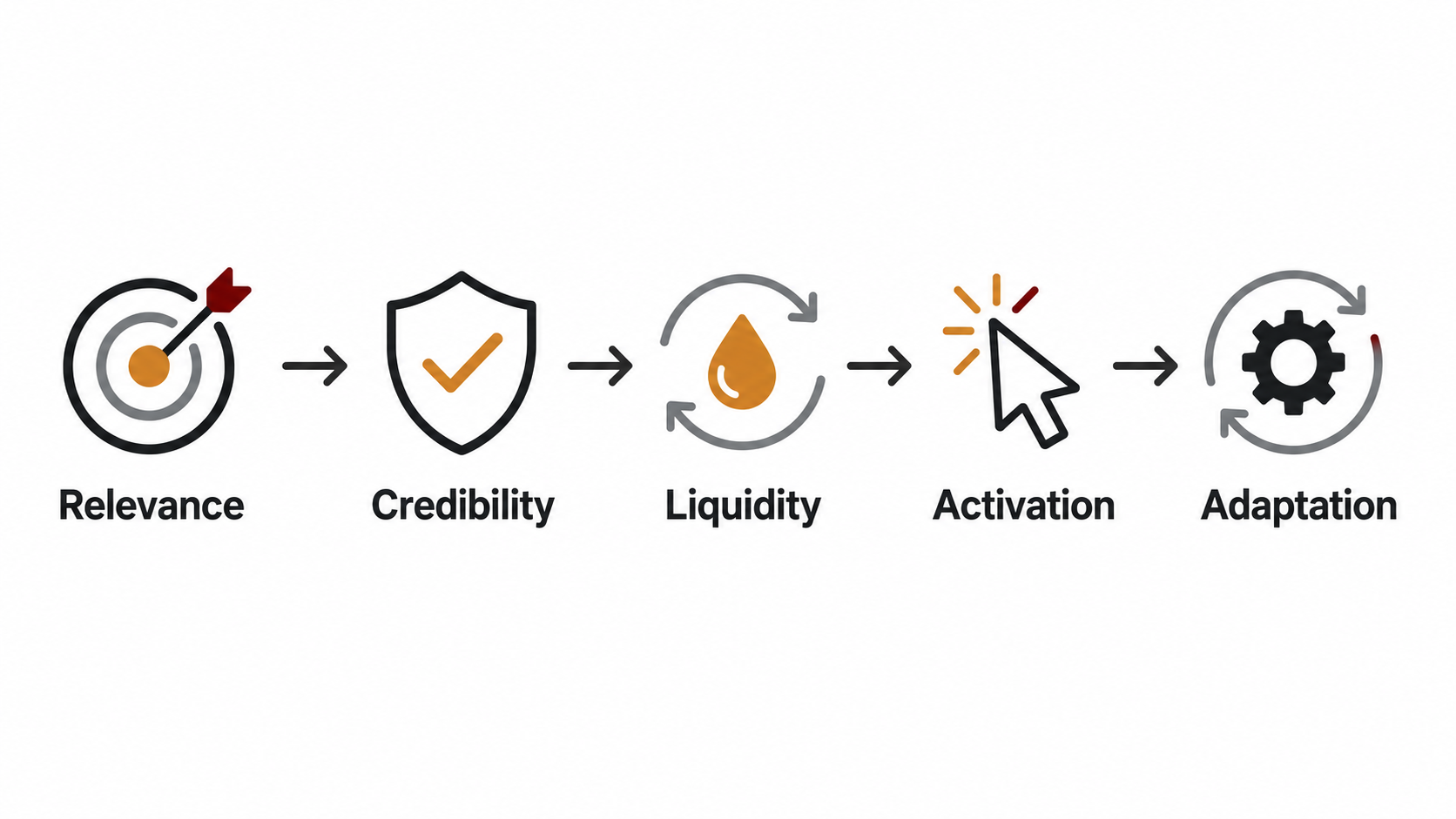
This is not a slogan. It is a decision model.
A stablecoin team should be able to look at any campaign, landing page, partnership, product update, exchange integration, wallet flow, sales deck, or lifecycle email and ask which layer it supports.
If the answer is unclear, the team is probably creating activity rather than growth infrastructure.
1. Relevance: start where the pain is already expensive
Relevance begins with the wedge.
A stablecoin team should not start with “Who might like stablecoins?” That question is too broad and usually leads to generic messaging.
A better question is:
Where is the current payment, savings, settlement, liquidity, or borrowing experience painful enough that a stablecoin creates immediate practical value?
That pain can show up in different places.
For a marketplace, it may be delayed seller payouts and high support volume around payment status. For a remittance product, it may be cost, speed, access, or currency instability. For a wallet, it may be the user’s need for a stable crypto-denominated balance. For an exchange, it may be liquidity, treasury movement, and trading pair efficiency. For a DeFi protocol, it may be borrowing, collateral, and composability.
The mistake is treating all of these as one audience.
They are not.
A CFO evaluating stablecoin settlement does not need the same message as a DeFi liquidity manager. A creator receiving global payouts does not need the same proof as an exchange operations team. A user in a high-inflation environment may care about access to stable value before they care about blockchain ideology.
Relevance means the team has identified the user’s painful moment before writing the campaign.
A practical decision rule:
Do not scale stablecoin messaging until the team can name the user, the pain, the current alternative, the stablecoin advantage, and the first action that proves value.
Without that, the team may generate attention. It will struggle to generate adoption.
2. Credibility: make trust visible before asking for action
Stablecoins carry a trust burden.
Users may ask whether the peg will hold, whether reserves are real, whether redemption is possible, whether liquidity will be available, whether cash-out works, whether the issuer is transparent, whether the product is compliant in their context, and what happens under stress.
Those questions do not sit outside the funnel. They are the funnel.
This is where many fintech teams weaken their own relevance. They identify a real use case, then ask users to move money before giving them enough confidence to act.
A relevant stablecoin offer needs a credibility stack.
That stack should usually include clear information about reserves, redemption rights where applicable, supported networks, liquidity access, custody model, fees, risk disclosures, compliance controls, incident response, supported jurisdictions, partner ecosystem, and user support.
For a mainstream buyer, the credibility stack may need to feel like payment infrastructure. For a crypto-native buyer, it may need to feel like technical reliability. For a regulated buyer, it may need to feel like operational control.
The important point is not that every user needs the same trust asset. The point is that every user needs a trust path.
A stablecoin team can have a strong product and still lose users if the proof is buried, vague, or scattered across five disconnected documents.
The relevance question here is:
What does this user need to believe before they will complete the first meaningful stablecoin action?
That question should shape the landing page, onboarding flow, sales narrative, help center, trust center, lifecycle emails, and partner materials.
Trust should not be a defensive page users find after they become worried. It should be part of the product experience from the beginning.
3. Liquidity: distribution chooses the winner more often than marketers admit
Stablecoins are not adopted in a vacuum.
A stablecoin can have a clean story and still struggle if users cannot access it where they already operate. Liquidity, exchange listings, wallet support, payment partners, on/off ramps, OTC desks, DeFi integrations, and stablecoin pairs all shape user behavior.
This is the uncomfortable part for marketers: sometimes the message is not the main constraint.
Sometimes the stablecoin is not relevant because it is not liquid enough in the places users need it.
That does not mean marketing has no role. It means marketing has to work with product, partnerships, ecosystem, liquidity, and business development instead of pretending a better headline can fix weak distribution.
A practical Stablecoin Growth OS should prioritize concentrated liquidity before broad narrative expansion.
Win one corridor deeply. Win one exchange flow. Win one wallet integration. Win one payment workflow. Win one DeFi use case. Win one partner channel where users can complete a real action. In my experience, that is part of the formula.
Stablecoin users often substitute between assets that appear to serve the same nominal purpose. When stress rises, when liquidity thins, when confidence drops, or when a competitor becomes easier to use, users can move quickly.
That makes liquidity a relevance signal.
A team should ask:
Can the user access, use, move, redeem, swap, settle, or deploy this stablecoin inside the workflow we are promising?
If the answer is weak, marketing should not overpromise adoption. It should help focus distribution on the use case where relevance can actually become behavior.
4. Activation: define the first meaningful stablecoin outcome
A user is not activated because they read an article, joined a waitlist, created a wallet, or viewed a dashboard.
Those are signals. They are not the outcome.
Stablecoin activation should be tied to the first meaningful use of the product. The exact event depends on the use case.
For a payments product, activation might be the first completed payout, first settled invoice, first recipient successfully onboarded, or first cash-out where supported.
For a wallet, it might be the first stablecoin receive, swap, send, balance hold, or repeat transaction.
For a DeFi product, it might be the first borrow, repay, collateral action, liquidity provision, or position management action.
For an exchange, it might be the first stablecoin deposit, trade, withdrawal, or trading pair conversion.
For a B2B crypto fintech product, activation might be the first pilot workflow completed with usable reporting, compliance review, and finance reconciliation.
The key is that activation must be useful to the user and commercially meaningful to the business.
A Stablecoin Growth OS should not celebrate surface activity as if it were adoption. It should define the first action that proves the product’s promise.
A useful activation question is:
What completed action would make the user say, “This solved the problem I came here with”?
That is the event worth optimizing.
5. Adaptation: relevance decays when the market changes
Stablecoin relevance is not permanent.
A product can be relevant in one liquidity environment and less relevant in another. It can be attractive under one interest-rate regime and less attractive when yields shift. It can feel safe until a competitor creates stronger transparency, better distribution, lower fees, or clearer redemption.
This is why rigid growth systems fail.
A Stablecoin Growth OS needs feedback loops. The team should monitor peg behavior, devaluation signals, redemption pressure, transaction velocity, liquidity depth, competitor spreads, user support patterns, churn reasons, borrowing behavior, payment completion, cash-out friction, and retention by segment.
The point is not to create a dashboard for dashboard theatre. The point is to detect when relevance is weakening before retention tells the team the hard way.
Adaptation also applies to messaging.
A stablecoin product may need different trust proof during calm markets than during stress. It may need stronger reserve communication during a confidence event. It may need clearer fee explanations when competitors change pricing. It may need deeper product education as users mature from first transaction to repeat use.
Relevance is not only about the first campaign. It is about staying useful as the user, product, and market evolve.
What teams usually get wrong
The first mistake is starting too broad.
“Stablecoin payments” is a category. It is not a wedge. “Help marketplace sellers receive USD-denominated payouts, cheaper and faster with clearer records and recipient support” is closer to a wedge because the user, workflow, and pain are visible.
The second mistake is treating trust as a legal or compliance appendix.
In crypto fintech, trust is part of activation. Users do not move value just because the copy is persuasive. They move value when the product feels useful, understandable, controlled, and credible enough for the next step.
The third mistake is confusing liquidity announcements with user access.
A listing, integration, or partnership only matters if it supports the workflow the user is trying to complete. Distribution that does not improve the activation path may help optics, but it may not improve adoption.
The fourth mistake is measuring attention instead of behavior.
Impressions, clicks, signups, and waitlists can diagnose interest. They do not prove stablecoin growth. The stronger question is whether users complete the first meaningful transaction, repeat it, trust the product more, and create evidence that sales, partnerships, or lifecycle teams can reuse.
The fifth mistake is assuming product design can remain fixed while the market changes.
Stablecoin users are sensitive to confidence, yield, liquidity, fees, and alternatives. A growth system that cannot adapt to those signals becomes fragile.
How to measure relevance inside a Stablecoin Growth OS
Relevance should be measured by movement through trust, activation, proof, and retention.
A useful measurement model includes five groups of metrics.
Segment relevance metrics
Track qualified traffic by segment, conversion by use case, demo quality, corridor-specific demand, and content engagement from the target ICP. A stablecoin product may look weak in aggregate but strong in one painful workflow.
That is where growth should investigate.
Trust metrics
Track trust-center visits, reserve/transparency page engagement, compliance FAQ views, risk-related support tickets, sales objections, drop-off before transaction, and recurring questions around custody, redemption, fees, jurisdiction support, and cash-out.
Activation metrics
Track first completed payout, first stablecoin receive, first send, first swap, first invoice settlement, first borrow, first liquidity action, first cash-out, or first completed pilot workflow. The correct metric depends on the product.
Retention metrics
Track second transaction rate, repeat usage by segment, active senders and receivers, retained balances where relevant, recurring payment flows, repeat borrowing, churn reasons, and defensive behavior during stress.
Commercial metrics
Track demo-to-pilot conversion, pilot-to-paid conversion, sales-cycle velocity, qualified inbound, partner-sourced activation, organic search traffic, AI/search referrals, founder or recruiter inbound, and revenue-aligned conversion.
The weakest stablecoin marketing systems stop at attention.
The strongest systems connect attention to relevance, relevance to trust, trust to activation, activation to proof, and proof to repeat use.
Relevance does not mean hiding crypto
A relevance-first Stablecoin Growth OS should not hide the crypto layer.
That would damage trust.
The point is sequencing.
For mainstream payment buyers, the stablecoin mechanism may need to appear after the business outcome and operational proof. For crypto-native buyers, the on-chain mechanism may need to appear early because it is part of the reason the product is credible. For regulated buyers, risk controls may need to appear before technical excitement. For DeFi users, composability, collateral design, peg behavior, and liquidity may matter immediately.
Good stablecoin marketing does not remove complexity.
It places complexity where the right user expects it.
That is the difference between simplifying and oversimplifying.
Simplifying helps users act. Oversimplifying makes sophisticated buyers distrust the product.
Commercial bridge
For wallets, exchanges, protocols, stablecoin issuers, payment startups, and crypto fintech teams, the practical question is not only:
“How do we explain stablecoins?”
The better question is:
“Where are stablecoins relevant enough to change behavior, what trust proof is missing, and how should the product move users from first transaction to repeat use?”
That is the work senior Web3/Crypto growth marketing should do.
A good Stablecoin Growth OS connects positioning, trust architecture, product education, activation analytics, lifecycle messaging, partner distribution, risk communication, and commercial proof. It helps teams stop treating marketing as a layer placed on top of the product and start treating it as part of the adoption system.
Because in stablecoins, credibility is not just what users believe.
It is what lets them act.
Stablecoin growth starts with relevance
Not broad relevance to the crypto category. Specific relevance to a painful user problem.
A Stablecoin Growth OS should identify where the product is urgently useful, build the trust proof required for action, concentrate liquidity where the workflow happens, define activation around a meaningful transaction, and adapt when market conditions change.
The stablecoin teams that win will not only explain the asset better.
They will prove where it matters.
Frequently Asked Questions
What is a Stablecoin Growth OS?
Why is relevance important for stablecoin growth?
How should a stablecoin team choose its first growth wedge?
What is the difference between awareness and activation in stablecoin marketing?
What trust proof should stablecoin teams provide?
How should stablecoin growth be measured?
Does relevance-first marketing mean avoiding crypto language?
What is the main business impact of a Stablecoin Growth OS?
Author note
Stefan Furcoi is a senior Web3/Crypto growth marketer focused on wallets, exchanges, protocols, stablecoins, and crypto fintech. His work connects positioning, trust architecture, compliant education, activation, retention, content authority, and measurable business outcomes.
Article Disclaimer
The content of this article is provided for general informational purposes only and does not constitute financial, investment, legal or tax advice. StefanFurcoi.com makes no representations or warranties regarding the accuracy or completeness of the information, and it should not be relied upon without consulting qualified professionals. Any views expressed are subject to change and do not reflect any commitment to update the information. You are solely responsible for your decisions and should conduct your own research before acting on any information.