First successful transaction as a Web3 activation metric
First successful transaction can be a strong Web3 activation metric when it is confirmed, value-relevant, cleaned for fake activity, and predictive of retention.


Does transaction equals activated user?
“First successful transaction” is one of the clearest Web3 activation metrics because it shows that a user crossed the gap between interest and on-chain action.
In Web2, a signup can be passive. In Web3, a real transaction usually asks more from the user: wallet setup, funding, signing, gas, confirmation, waiting, risk perception, and visible value delivery. That makes the first successful transaction more meaningful than a click, a page view, or even a wallet connection.
But the metric needs discipline.
A first transaction is not automatically activation. It may be an approval, a dust transfer, a bot action, a wash trade, a test wallet, a one-time speculative click, or an airdrop-farming move. The better definition is this:
A user is activated when they complete a confirmed, value-relevant, non-manipulated on-chain action with acceptable cost, time, & friction. That action predicts later meaningful usage.
That is the difference between counting activity and measuring activation.
Activity vs Activation
A first successful transaction is a strong Web3 activation metric when it proves the user completed the product’s core value action, the transaction succeeded technically, the user received a visible product outcome, and the behavior predicts future usage.
It is not enough to count any successful on-chain event. Wallet connections, approvals, test transactions or failed transactions, dust transfers, bot-like behavior, wash trades, and incentive-only activity can make a dashboard look healthy while hiding weak adoption.
The activation workflow
| Workflow step | What it checks | Why it matters |
|---|---|---|
| Define the core transaction | The action matches the product’s real value moment | Prevents teams from counting easy but shallow events |
| Confirm technical and product success | The transaction is confirmed, non-reverted, visible, and useful | Proves the user actually received the intended outcome |
| Clean and validate the metric | Fake activity is removed and retention improves afterward | Turns a transaction count into a reliable activation signal |
Many Web3 teams confuse activity with activation
Most Web3 dashboards can make a team feel busy before they prove anything meaningful.
A wallet connected.
A transaction happened.
A contract emitted an event.
A chart went up.
That feels like progress, but it may only be activity.
The problem is that on-chain data is both more objective and more misleading than many Web2 metrics. It is more objective because a confirmed transaction can show a real state change. It is more misleading because wallets, bots, incentives, wash trades, and speculative behavior can create activity that looks like adoption without proving durable user value.
A wallet connect is not activation.
A token approval is not activation.
A failed swap is not activation.
A bridge transaction that never becomes visible on the destination chain is not activation.
A dust transfer from a sybil wallet is not activation.
For Web3 growth teams, the better question is not:
“How many users transacted?”
The better question is:
“How many real users completed the product’s core value action in a way that made them more likely to return?”
That is where first successful transaction becomes useful. Not as a vanity metric, but as a quality gate.
Who this matters for
This metric matters for any Web3 product where the real value moment depends on an on-chain action.
For a wallet, the first successful transaction might be the first send, receive, swap, stake, or dApp interaction. For a DEX, it might be the first completed swap where the expected output arrives. For a bridge, it should usually mean the transfer is complete on the destination chain, not just submitted on the source chain. For a lending protocol, it might be the first deposit, borrow, repay, or collateralized position. For a DAO, it might be a vote, delegation, proposal action, or contribution proof.
The same logic applies to exchanges, stablecoin products, NFT marketplaces, crypto fintech apps, and Web3 games.
The decision rule is simple:
Activation should map to the product’s value promise, not the easiest event to count.
Why this matters now
Web3 gives growth teams something unusually powerful: a visible proof layer.
Smart-contract activity can often show whether a user actually did the thing the product promised: swapped, minted, bridged, deposited, borrowed, staked, listed, voted, transferred, or interacted with a protocol. That makes Web3 more measurable than many digital products.
But transparency does not remove the need for judgment.
A transaction can be technically valid and still commercially meaningless. A wallet can complete one action and never return. A trader can generate volume without genuine market demand. A user can act only because an airdrop, points program, token incentive, or market hype cycle pushed them to do so.
This is why first successful transaction should not be treated as a standalone trophy. It should be cleaned, contextualized, and validated against retention.
A good activation metric does not only show that something happened.
It shows that the right user reached the right value moment and became more likely to keep using the product.
The first transaction quality gate
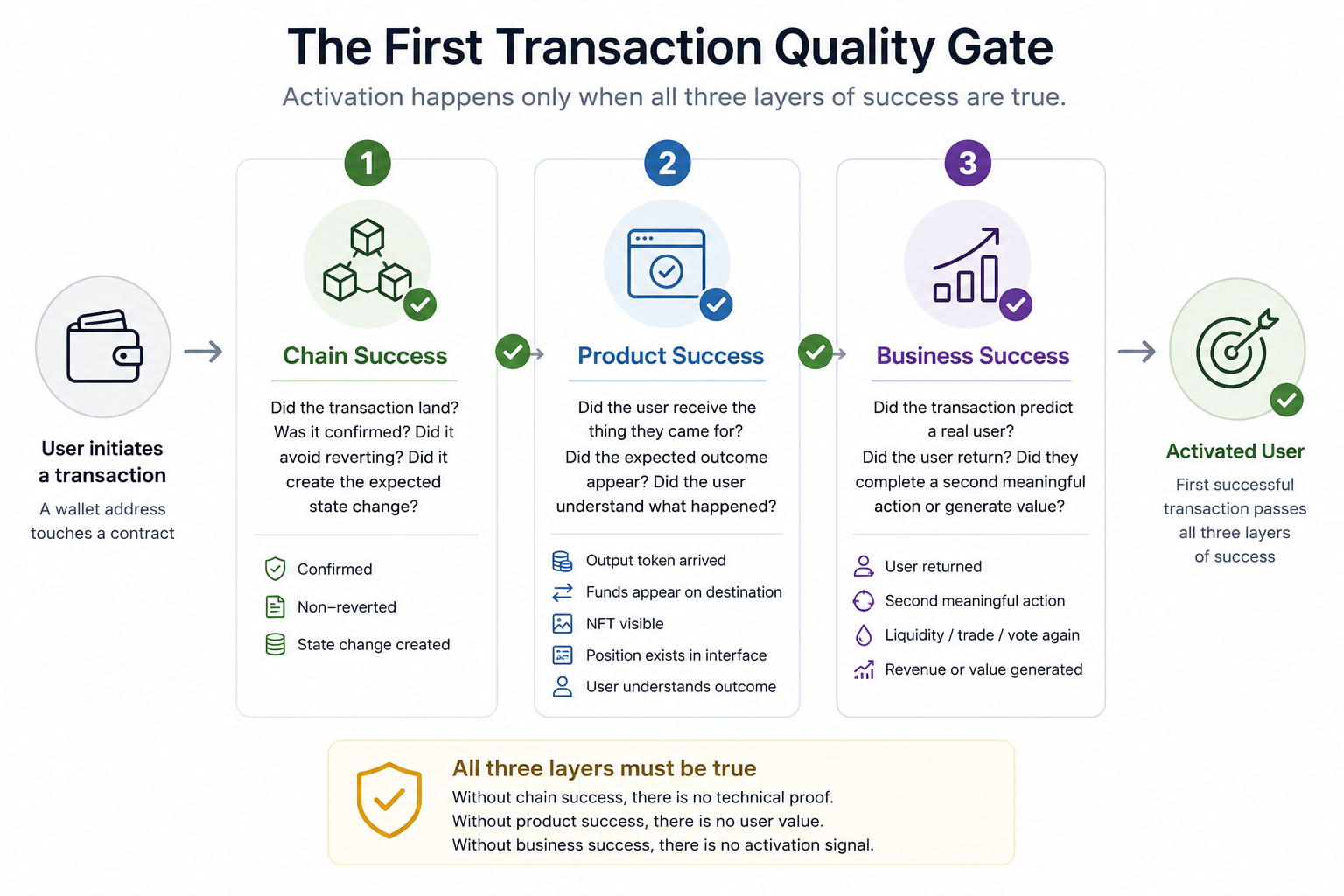
The most useful way to think about this metric is the First Transaction Quality Gate.
A user is not activated just because a wallet address touched a contract. They are activated when the first transaction passes three layers of success: chain success, product success, and business success.
Chain success asks whether the transaction landed. Was it confirmed? Did it avoid reverting? Did it create the expected state change?
Product success asks whether the user received the thing they came for. Did the output token arrive? Did the bridged funds appear? Did the NFT show up? Did the lending position exist in the interface? Did the user understand what happened?
Business success asks whether the transaction predicted a real user. Did the user return? Did they complete a second meaningful action? Did they add liquidity, trade again, vote again, borrow again, send again, or generate revenue?
A founder should not celebrate “first successful transaction” until all three layers are reasonably true.
Without chain success, there is no technical proof.
Without product success, there is no user value.
Without business success, there is no activation signal.
Define the real activation transaction first
The weakest version of this metric is “any wallet with any successful transaction.”
That is not activation. That is noise in a suit.
Before measuring first successful transaction, the team needs to define the product’s true value moment in plain language. A DEX should not count a token approval as activation if the real value is the completed swap. A bridge should not count the source-chain transaction if the user never sees funds on the destination chain. A wallet should not count account creation if the product promise is sending, receiving, swapping, staking, or using dApps.
A more useful definition might look like this:
“An activated DEX user is a wallet that completes a confirmed swap, receives the expected output token, pays costs within an acceptable threshold, is not flagged as bot-like or wash-like, and is more likely to complete a second meaningful swap within 30 days.”
Confirm technical success, but do not stop there
The first layer is technical.
A successful transaction should be confirmed or finalized on the relevant chain. It should not revert or fail. It should emit the expected event or create the expected state change. The user’s balance, position, ownership, vote, listing, deposit, or transfer should reflect the intended result.
But technical success is only the beginning.
A transaction can be confirmed while the interface still shows an outdated balance. A bridge transfer can succeed on one side while the user remains confused on the other. A mint can complete while the NFT is not visible in the marketplace or wallet view.
The chain may be right, but the user experience can still fail.
That is why product success matters. Users do not care about event logs. They care about whether the product delivered the thing they came for.
The transaction is the proof layer. The interface is the confidence layer.
Measure friction, not just completion
A transaction that succeeds after ten failed attempts is not the same as one that succeeds smoothly.
That distinction matters because Web3 activation is often lost in the friction around the transaction, not only inside the transaction itself.
Teams should look at how long it takes users to reach the first successful transaction, how many failed or rejected attempts happen before success, how many signatures and approvals are required, how gas and fees affect completion, whether slippage or price impact damages the experience, and whether the user sees clear pending, confirmed, and post-transaction states.
A founder may look at a completed transaction and see success.
A user may remember confusion, fees, wallet prompts, failed attempts, and uncertainty.
Both views matter. Only one predicts retention.
Clean the metric for fake or low-quality activity
Raw Web3 activity can lie.
That does not make on-chain analytics useless. It means the analytics need cleaning before the team calls the metric activation.
Teams should remove or flag internal wallets, deployer wallets, treasury wallets, test wallets, bots, MEV searchers, relayers, routers, keepers, airdrop farmers, incentive-only behavior, dust transfers, self-transfers, circular flows, repeated equal-size transfers, trades with no meaningful net position change, and wash-trading patterns.
The reason is simple: if the metric counts fake activity as activation, the team will make bad decisions.
It may overestimate product-market fit. It may misunderstand acquisition quality. It may misprice incentives. It may spend more money acquiring users who were never real users in the first place.
In Web3, analytics hygiene is growth strategy.
Separate activation from speculation
A user can complete a real transaction for the wrong reason.
That does not make the transaction worthless, but it changes how the team should interpret it.
A first successful transaction may be driven by an airdrop rumor, a points campaign, token speculation, NFT hype, gas subsidies, farming behavior, or market volatility. The user may not care about the product’s actual utility. They may only care about the incentive.
The practical test is:
Would this user still complete the transaction without the airdrop, points program, subsidy, or short-term speculative upside?
If the answer is no, label the cohort properly. Do not bury it inside clean activation.
Incentive response can be useful. It can create liquidity, bring users into the ecosystem, or help test product flows. But it should not be confused with durable adoption.
Validate first transaction against retention
This is the step that turns the metric from a milestone into a real activation signal.
A first successful transaction matters only if users who complete it are meaningfully more likely to continue using the product.
For a wallet, that might mean a second send, swap, stake, or dApp interaction. For a DEX, it might mean repeat swaps or higher-quality trading behavior. For a lending protocol, it might mean position duration, additional deposits, repayments, or liquidation-adjusted value. For a DAO, it might mean second vote, delegation persistence, or contribution quality. For a game, it might mean repeat sessions or progression.
The metric passes when:
Clean first successful transaction leads to higher repeat usage, retention, revenue, liquidity, participation, or qualified behavior.
It fails when:
Clean first successful transaction creates no meaningful difference in repeat behavior or business value.
Without that validation, first transaction is only an onboarding milestone.
With validation, it becomes an activation metric.
What teams usually get wrong
The most common mistake is counting the easiest on-chain event instead of the meaningful one.
Wallet teams count wallet creation. Protocols count approvals. Bridges count source-chain sends. Marketplaces count low-quality listings. DAOs count token-gated access. Games count any contract interaction instead of the first gameplay-relevant state change.
The second mistake is treating every wallet as a user. One person can control many wallets. One bot can look like many users. One incentive campaign can create thousands of wallets that disappear once rewards end.
The third mistake is ignoring the felt experience. A transaction can be confirmed and still feel awful because of gas, slippage, chain switching, signing anxiety, poor pending states, or unclear post-transaction guidance.
The fourth mistake is not checking retention. Teams celebrate first transaction counts while second transaction rates quietly collapse.
That is usually the moment when marketing gets blamed for a measurement problem.
What to do instead
Define the chosen activation transaction in one sentence that product, marketing, analytics, and support can all understand.
Then instrument the full journey: wallet connect, funding, approval, signing, pending, confirmation, failure, and post-transaction state. Separate technical success from product success. Add economic thresholds so dust activity does not pollute the metric. Flag suspicious wallets and manipulated patterns. Segment organic users from paid, referral, incentive, partner, and market-driven cohorts.
Most importantly, compare users who complete a clean first successful transaction with users who do not.
The question is not whether the transaction happened.
The question is whether that transaction created a user who was more likely to return, transact again, generate value, or move deeper into the product.
This is where Web3 marketing becomes more than acquisition. It becomes a system for turning user intent into verified behavior.
How to measure success
The strongest dashboard should include more than first transaction count.
Track clean first successful transaction rate, time to first successful transaction, failed attempts before success, median cost to first transaction, approval-to-core-action conversion, first-to-second transaction rate, 7/14/30-day retention by activation cohort, revenue or fee contribution by activated users, support tickets per activated user, suspicious activity exclusion rate, and incentive-adjusted retention.
The most important signal is the gap between users who complete a clean first successful transaction and users who do not.
If that gap is strong across retention, repeat usage, and business value, the metric matters.
If the gap is weak, the definition needs work.
Not every Web3 product should force a transaction too early
This does not mean every Web3 product should push users into an on-chain action immediately.
Some products need education, funding, identity checks, compliance steps, risk disclosures, or social onboarding before a transaction makes sense. Some products use embedded wallets, account abstraction, gas sponsorship, or off-chain pre-activation flows. Some exchanges and crypto fintech apps may treat funding, verification, or first trade as a better activation signal than a public on-chain transaction.
The principle still holds:
Activation should measure the first meaningful value moment.
If that value moment is on-chain, first successful transaction can be powerful. If it is not yet on-chain, the team should define the nearest meaningful behavior that predicts retention.
The mistake is not choosing a different activation metric.
The mistake is choosing one that does not predict future usage.
Commercial bridge
For wallets, exchanges, protocols, and crypto fintech teams, the practical question is not only:
“How many users did we acquire?”
It is:
Where did users hesitate?
Which first action proved real intent?
Which transaction created confidence?
Which cohorts returned?
Which acquisition sources produced repeat usage?
Which incentives created noise instead of retention?
That is the work of senior Web3 growth: connecting narrative, onboarding, transaction design, trust signals, analytics, and retention into one system.
A campaign can drive users to the door. The first successful transaction shows whether the product helped them cross it. Retention shows whether they had a reason to stay.
The best Web3 activation metrics
A first successful transaction is one of the best Web3 activation metrics when it is treated with discipline.
It should be confirmed, non-reverted, value-relevant, visible in-product, economically meaningful, cleaned for manipulation, and validated against retention.
Without those conditions, it is just an on-chain event.
With those conditions, it becomes proof that the user crossed the Web3 friction barrier, received the product’s core value, and became more likely to keep using the product.
That is activation worth measuring.
Frequently Asked Questions
What is first successful transaction as a Web3 activation metric?
It is the first confirmed, non-reverted, user-initiated, non-manipulated on-chain action that completes the product’s core value proposition and predicts future meaningful usage.
Is any successful transaction enough to count a user as activated?
No. Token approvals, wallet connections, failed transactions, dust transfers, bot actions, wash trades, or test transactions should not automatically count as activation.
Why is first successful transaction better than wallet signup?
Wallet signup shows access. A first successful transaction shows action. In Web3, that usually means the user signed, paid, waited for confirmation, and received a meaningful outcome.
What should a wallet count as a first successful transaction?
A wallet should usually count a first send, receive, swap, stake, or dApp interaction, depending on its core value proposition. Wallet creation alone is onboarding, not activation.
How should a DEX define first successful transaction?
A DEX should usually define it as a completed swap where the user receives the expected output token, the transaction is confirmed, the amount is meaningful, and the wallet is not flagged as bot-like or wash-like.
How do teams clean first transaction data?
Teams should remove or flag internal wallets, test wallets, bot-like addresses, sybil clusters, dust transactions, circular flows, wash-trading patterns, and incentive-only behavior.
How do you know whether first successful transaction predicts retention?
Compare users who complete the clean activation transaction with users who do not. If the activated cohort has higher second transaction rate, retention, revenue, liquidity, or participation, the metric is useful.
What is the biggest mistake with this metric?
The biggest mistake is celebrating first transaction counts without checking whether those transactions are meaningful, clean, and predictive of future behavior.
Author note
Stefan Furcoi is a senior Web3/Crypto growth marketer focused on wallets, exchanges, protocols, and crypto fintech. His work connects positioning, trust architecture, compliant education, activation, retention, content authority, and measurable business outcomes.
Disclaimer: The content of this article is provided for general informational purposes only and does not constitute financial, investment, legal or tax advice. StefanFurcoi.com makes no representations or warranties regarding the accuracy or completeness of the information, and it should not be relied upon without consulting qualified professionals. Any views expressed are subject to change and do not reflect any commitment to update the information. You are solely responsible for your decisions and should conduct your own research before acting on any information.