Stablecoin payout pilot framework for marketing teams: how to turn payouts into trust, retention, and proof
A research-backed stablecoin payout pilot framework for marketing teams, covering creator payouts, affiliate commissions, contractor payments, trust, off-ramps, compliance, and continuance metrics.


Article Brief
Stablecoin payout pilot framework
A compact strategic brief for marketing teams evaluating stablecoin payouts across creators, affiliates, agencies, contractors, ambassadors, and cross-border partner programs.
| Core thesis | Stablecoin payouts should be treated as a recipient trust system, not just a payment rail. |
|---|---|
| Best-fit use case | High-friction recurring payouts: creators, affiliates, agencies, contractors, ambassadors, and cross-border partner programs. |
| Strategic framework | Painful corridor → Recipient fit → Reserve-credible rail → Privacy and auditability → Off-ramp and fallback → Continuance scorecard → Compliance checkpoint. |
| What teams miss | The first payout proves technical ability. The second payout proves recipient trust. |
| Main growth metric | First-to-second payout repeat rate, supported by settlement time, payout cost, support-ticket rate, off-ramp success, and recipient satisfaction. |
| Business outcome | Lower payout friction, stronger partner retention, cleaner operational proof, and a more credible stablecoin growth story. |
Executive summary
Stablecoin payouts are not automatically better because they use crypto rails. They become strategically useful when they solve a real payout problem that traditional systems are already failing to solve: cross-border delays, expensive small payments, unclear settlement timing, poor recipient experience, or friction-heavy repeat payouts.
The research base is still developing. There are fewer direct peer-reviewed examples of end-to-end stablecoin payout pilots run by marketing teams than a strict evidence filter would ideally produce. But the available studies point in a consistent direction: stablecoin payout pilots are strongest when they start with one painful corridor, one clear recipient segment, a reserve-credible asset, privacy-aware architecture, off-ramp support, and a continuance scorecard.
For marketing teams, the strategic lesson is simple: payouts should be treated with the same seriousness as onboarding.
Onboarding gets someone into the system. Payouts prove whether the system keeps its promise.
Direct answer
A stablecoin payout pilot for marketing teams should start with one high-friction payout corridor, not a company-wide rollout. The strongest pilot design combines recipient education, reserve-credible stablecoin selection, privacy and auditability, off-ramp support, fallback routes, and metrics that measure repeat payout behavior rather than only first-time opt-ins.
The business goal is not to “use crypto payouts.” The business goal is to reduce payout friction, increase recipient trust, improve retention, lower operational support burden, and create proof that the payout system works under real conditions.
The problem: stablecoin payouts are often framed as a rail before they are proven as an experience
Marketing teams love smooth words.
“Global payouts.”
“Instant settlement.”
“Borderless payments.”
“Crypto-native rewards.”
Those phrases are not useless. They are just incomplete.
A creator does not care that the payment rail is modern if they cannot understand how to receive the funds. An affiliate does not care that settlement is on-chain if the off-ramp is confusing. A contractor does not care that the transaction is traceable if the process exposes their compensation history or creates tax-documentation headaches.
That is why stablecoin payouts should not be evaluated only as a treasury experiment. For marketing teams, they are a trust system.
The payout is one of the most emotionally important moments in a creator, affiliate, ambassador, agency, or contractor relationship. It is the moment where the brand’s promise becomes tangible. If the payment arrives late, costs more than expected, requires awkward support, or feels risky, the relationship weakens. If it arrives clearly, quickly, and with enough confidence for the recipient to use it, the relationship gets stronger.
This is the operating problem: many teams treat payout innovation as a back-office payment decision when it is actually a growth, retention, and trust decision.
Plain-language explanation: what is a stablecoin payout pilot?
A stablecoin payout pilot is a controlled test where a company pays a specific group of recipients using stablecoins instead of, or alongside, traditional payout methods.
For a marketing team, those recipients might include creators, affiliates, ambassadors, contractors, agencies, community contributors, newsletter partners, referral partners, or micro-influencers.
The pilot should answer practical questions:
Can recipients understand the payout method?
Can they receive the funds successfully?
Can they use or off-ramp the value where available?
Does the process reduce payout delay or cost?
Does it create fewer support tickets or more?
Does it increase trust or introduce anxiety?
Do recipients want to use it again?
A weak pilot only asks, “Can we send stablecoins?”
A strong pilot asks, “Does this payout system improve trust, completion, retention, and operating efficiency for this specific recipient segment?”
That difference matters.
One is a technical test. The other is a growth system.
The strongest insights:
The strongest insights derived from my own research is not that stablecoins are universally better than traditional payment rails. The stronger, more useful conclusion is narrower: stablecoins appear most strategically relevant where payout pain is already measurable.
That includes cross-border contractors, creators, affiliates, agencies, remittance-like corridors, and high-frequency micro-payouts.
First, stablecoin market fit depends on credibility and ecosystem support. The USDT case study highlighted factors such as early-mover advantage, reserve maintenance, resilience, multi-chain availability, ecosystem growth, and regulatory constraints. For payout pilots, that means the stablecoin itself is not a neutral detail. Reserve credibility, liquidity, chain support, wallet compatibility, and market recognition all shape whether recipients trust the payout.
Second, adoption and continuance are not the same thing. The remittance adoption is especially useful because it separates the first “yes” from repeat use. Digital and financial literacy can help people adopt stablecoin remittances, but satisfaction and perceived usefulness drive continuance. That lesson maps directly to creator, affiliate, and contractor payouts. A recipient may agree to try a stablecoin payout once. They will only keep using it if the experience feels useful, understandable, and safe enough.
Third, privacy and auditability are not optional. Public blockchain records can help with transparency and verification, but they can also expose sensitive commercial data. Creator rates, influencer relationships, agency retainers, contractor compensation, campaign volume, and wallet histories may all become visible in ways that create business risk. This aspect helps frame the real enterprise problem: teams need auditability without careless exposure.
Fourth, cross-border stablecoin frameworks show why payout teams care about interoperability, data exposure, and settlement time. One framework paper reported modeled improvements including lower data exposure risk, higher interoperability, and faster transaction times. The exact numbers should be treated as framework-based evidence rather than proof of every real-world deployment, but the KPI categories are useful: speed, cost, interoperability, privacy, and operational reliability.
Fifth, cross-chain design matters because recipients do not all live in the same wallet, chain, exchange, or local market context. A stablecoin service tailored for cross-chain transactions is not just a technical architecture concept. For payout teams, route flexibility can become part of recipient satisfaction.
The pattern is clear: payout success is not only about the sender’s ability to transmit value. It is about the recipient’s ability to receive, trust, use, and repeat the experience.
The main patterns across the narrative
1. The strongest use cases are high-friction payout workflows
Overall, marketing teams are advised to distance themselves from adopting the lazy “stablecoins beat banks” argument.
Stablecoins are most relevant where traditional payout systems are slow, expensive, opaque, or operationally frustrating.
That is why creator payouts, affiliate payments, contractor payments, agency payments, remittance-like corridors, and micro-payouts are stronger starting points than broad consumer checkout. In these workflows, payment friction is not theoretical. It shows up as delays, support tickets, recipient frustration, lower partner retention, and awkward finance operations.
A marketing team should not begin by asking, “Where can we use stablecoins?”
The better question is:
“Where are payment delays already hurting trust, retention, or operating efficiency?”
That question points to the right wedge.
2. Trust is not a message; it is the payout architecture
In Web3, trust is often treated as a brand problem.
For payouts, trust is much more concrete.
It includes the stablecoin selected, the chain used, the wallet experience, the off-ramp path, the fee explanation, the support flow, the compliance process, the fallback route, the tax documentation, and the way the recipient understands what just happened.
A recipient does not separate “marketing” from “product” during a payout. They experience one system.
If the message says “fast global payouts,” but the recipient has to ask five questions before using the money, trust decreases.
If the message explains the workflow clearly, shows expected fees, gives supported wallet and off-ramp options, provides fallback support, and confirms receipt in plain language, trust increases.
The marketing team’s job is not only to promote the payout option. It is to help design the confidence layer around it.
3. The second payout is the real market-fit test
The first payout proves that a recipient was willing to try.
The second payout proves that the experience was good enough to repeat.
That is why continuance should be central to the pilot scorecard. Opt-ins can be inflated by curiosity, incentives, or one-time convenience. Repeat payout behavior is harder to fake.
For creators, affiliates, agencies, and contractors, recurring payouts are relationship moments. Every successful payout strengthens confidence. Every confusing payout creates doubt. If a payout method makes the recipient feel more in control, more informed, and less dependent on slow support, it can improve retention.
If it adds uncertainty, it may damage the relationship even if the transaction technically succeeded.
This is where senior marketing judgment matters. A blockchain explorer can say the transaction landed. The recipient still decides whether the experience felt acceptable.
4. Public transparency can become commercial exposure
Blockchain transparency can be useful for verification and audit trails. But marketing teams need to be careful with the other side of that transparency.
Payout metadata can reveal compensation patterns, creator relationships, campaign intensity, wallet behavior, and payment timing. For some teams, that exposure may be unacceptable.
A payout pilot should therefore avoid simplistic thinking such as, “It is on-chain, so it is transparent, so it is good.”
The better framing is:
“Finance needs auditability. Recipients need confidence. The business needs commercial privacy. Compliance needs reviewability. The architecture must balance all four.”
That is why privacy and auditability belong in the pilot design, not in a later cleanup phase.
The key differences and tensions
Stablecoin success vs. stablecoin fragility
A USDT case shows that liquidity, recognition, reserves, resilience, and multi-chain availability can help a stablecoin achieve broad adoption. But broader stablecoin research also pays serious attention to volatility, peg deviations, design risk, and failure modes.
For marketing payouts, the implication is practical: use stablecoins for payout utility, not speculative novelty. A professional payout pilot should prefer reserve-credible, liquid, widely supported assets unless the explicit goal is technical experimentation.
The point is not to chase the most exciting stablecoin. The point is to reduce payout anxiety.
Efficiency vs. regulation
Stablecoin payment frameworks often emphasize faster settlement, lower friction, and improved interoperability. Regulators, however, continue to warn that payment innovation should not bypass risk-based standards.
For payout teams, this means compliance cannot be treated as the boring department that slows down the pilot.
Compliance is what makes the pilot scalable.
A serious payout pilot needs jurisdiction rules, recipient eligibility checks, sanctions screening, wallet-risk checks, tax-documentation workflows, audit trails, and clear disclosures before value starts moving.
If the pilot cannot survive compliance, finance, and support pressure, the campaign is not the problem.
Transparency vs. privacy
On-chain payments can create clearer records, but they can also expose sensitive information.
That tension is especially important for creator and contractor payouts. Influencer fees, agency retainers, contractor rates, campaign budgets, and partner relationships can be commercially sensitive.
Marketing teams need to think like operators here. A payout flow that is technically transparent but commercially reckless is not enterprise-ready.
Adoption vs. continuance
Digital and financial literacy may increase a recipient’s willingness to try stablecoin payouts. But satisfaction and perceived usefulness are what drive repeat use.
This distinction should change how teams design pilots.
Education is necessary, but education alone is not the product. The product is the completed, understood, usable payout.
A recipient does not continue because they watched an onboarding video. They continue because the payout arrives, makes sense, costs what they expected, and can be used without a support maze.
Universal payment rail vs. corridor-specific wedge
Stablecoins are often marketed as universal payment rails.
That may be directionally attractive, but it is usually too broad for a first pilot. Marketing teams should not start with “pay everyone everywhere.”
They should start with one painful corridor and one recipient segment.
A U.S. company paying LATAM creators is a different problem from a Canadian team paying Southeast Asian contractors. A small affiliate payout is different from an agency retainer. A community reward is different from a professional contractor invoice.
Stablecoin payout strategy gets stronger when it stops trying to prove the entire category and starts proving one workflow.
The corridor-to-continuance payout framework
A useful stablecoin payout pilot should move through seven layers:
Painful corridor → Recipient fit → Reserve-credible rail → Privacy and auditability → Off-ramp and fallback → Continuance scorecard → Compliance checkpoint
This framework keeps the team from making the most common mistake: choosing the technology before defining the adoption problem.
1. Painful corridor first
Start where the old payout system is visibly broken.
That might be a creator program where international recipients wait too long to get paid. It might be an affiliate program where small commissions are expensive to distribute. It might be a contractor workflow where traditional bank transfers create delays and uncertainty. It might be an ambassador program where frequent micro-payouts overwhelm manual operations.
The first pilot should not be “all marketing payouts.”
It should be:
One corridor.
One recipient segment.
One payout type.
One baseline comparison.
One hero metric.
For example: “Pay 25 LATAM creators under a specific monthly payout threshold and compare settlement time, support tickets, payout cost, and repeat participation against the previous payout method.”
That is specific enough to learn from.
2. Recipient-fit before rail-fit
Many teams choose the chain first because the technical team is excited about infrastructure.
That is backwards.
A payout pilot should begin with the recipient’s readiness, not the sender’s preferred rail. Does the recipient understand stablecoins? Do they already use a wallet or exchange? Are they comfortable with self-custody? Do they need custodial support? Is there a usable off-ramp in their region? Are fees clear? What language or documentation do they need?
The pilot should segment recipients by practical readiness:
New to stablecoins
Some crypto experience
Crypto-native
Business recipient
Agency recipient
High-frequency small payout recipient
Larger recurring contractor recipient
Each segment needs different education, support, and risk messaging.
A crypto-native ambassador may want network details. A mainstream creator may need reassurance that they can receive, hold, convert, or report the payout correctly where available.
Same rail. Different trust path.
3. Reserve-credible asset selection
For a marketing payout pilot, asset selection is not a branding accessory. It is part of the trust experience.
Recipients need confidence that the value they receive is understandable, liquid, and supported by services they can actually use. Finance teams need a clear asset policy. Compliance teams need to understand the risk profile. Support teams need to know how to answer basic questions.
This does not mean every team should use the same stablecoin or chain. It means the decision should be tied to reserve credibility, liquidity, wallet support, exchange/off-ramp availability, jurisdiction rules, fee profile, and recipient familiarity.
Experimental stablecoins may be appropriate for technical research. They are usually a poor default for professional marketing payouts.
A payout pilot is not the place to make recipients feel like test subjects.
4. Privacy and auditability layer
A payout pilot needs records. But it also needs discretion.
Finance needs to know what was paid, when, to whom, under which campaign, and with what approval. Compliance needs reviewability. Recipients need confidence that sensitive details are not casually exposed. The business needs to avoid leaking partner economics.
That means the pilot should define:
What information is recorded internally
What appears on-chain
What recipients can see
What finance can export
What compliance can review
What support can access
What should never be publicly exposed
How wallet risk checks are handled
How failed or mistaken payouts are escalated
Privacy is not a cosmetic feature here. It is part of operational acceptability.
5. Off-ramp and fallback design
The payout is not complete when the token lands in a wallet.
The payout is complete when the recipient can use the value with confidence.
That may mean holding the stablecoin, spending it through a supported platform, converting it where available, transferring it to a preferred wallet, or using a compliant off-ramp. The exact path depends on jurisdiction, provider availability, and recipient preference.
A serious pilot should explain the off-ramp path before the first payment is sent.
It should also include fallback routes. What happens if the recipient cannot access the wallet? What if they select the wrong network? What if the off-ramp is unavailable? What if compliance blocks a payout? What if the recipient decides they prefer traditional payment after the first test?
Fallback design reduces fear. It also protects the brand.
6. Continuance scorecard
The pilot should not be judged by opt-ins alone.
Opt-ins measure willingness to try. Continuance measures whether the system earned repeat trust.
A useful scorecard should include:
Opt-in rate
Successful first payout rate
Median settlement time
Cost per payout
Support-ticket rate
Off-ramp success rate
Recipient satisfaction
Perceived usefulness
First-to-second payout repeat rate
Partner retention after payout
Failed or delayed payout rate
Compliance review outcomes
Recipient confidence score
The most important number may be the first-to-second payout repeat rate.
If recipients try stablecoin payouts once but do not want them again, the pilot has not proven market fit. It has proven curiosity.
7. Compliance checkpoint
Stablecoin payout pilots need compliance discipline from the start.
That does not mean every marketing team needs to become a legal department. It means the pilot should not move money before the internal rules are clear.
The team should define supported jurisdictions, prohibited regions, recipient documentation requirements, tax considerations, sanctions screening, wallet risk checks, disclosure language, approval workflows, transaction monitoring, and escalation procedures.
This is also a messaging issue.
Recipients should not be surprised by eligibility checks, documentation requests, fees, network choices, or restrictions. Clear expectations reduce support burden and protect trust.
Compliance-aware education is not the enemy of growth. In crypto fintech, it is one of the reasons growth can survive.
What marketing teams usually get wrong
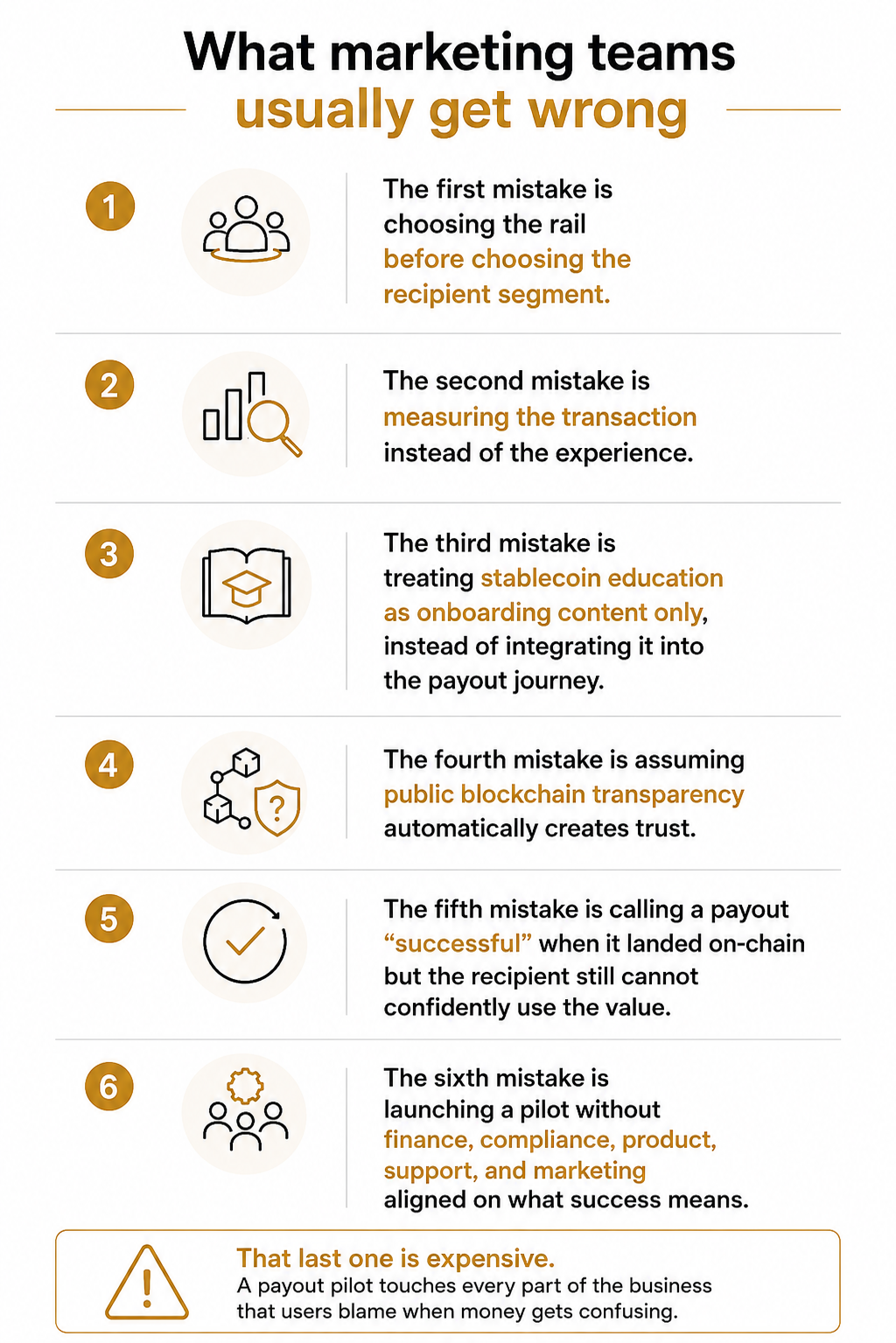
The first mistake is choosing the rail before choosing the recipient segment.
The second mistake is measuring the transaction instead of the experience.
The third mistake is treating stablecoin education as onboarding content only, instead of integrating it into the payout journey.
The fourth mistake is assuming public blockchain transparency automatically creates trust.
The fifth mistake is calling a payout “successful” when it landed on-chain but the recipient still cannot confidently use the value.
The sixth mistake is launching a pilot without finance, compliance, product, support, and marketing aligned on what success means.
That last one is expensive.
A payout pilot touches every part of the business that users blame when money gets confusing.
What to do instead
Start with the recipient’s pain.
Document the current payout workflow. Measure how long payouts take, what they cost, where they fail, how many support tickets they create, and how recipients describe the experience.
Then define the pilot wedge. Choose one segment where stablecoins could plausibly improve the workflow. Do not start with the largest possible rollout. Start with the sharpest learning opportunity.
Build the recipient education layer before the first payout. Explain what the stablecoin is, which network is used, what fees may apply, what the recipient should check, how they can access the value, what support exists, and what alternatives are available.
Align internally on risk. Finance, compliance, product, support, and marketing should all know the pilot rules.
Then run the smallest test that can produce credible proof.
The proof should not be “we used stablecoins.”
The proof should be something like:
Creators received payouts faster with fewer payment-status tickets.
Affiliates completed small recurring payouts with lower operational friction.
Contractors reported higher confidence after the second payout.
Finance reduced reconciliation ambiguity.
Support identified the top recipient confusion points before scaling.
Compliance approved a repeatable process for specific jurisdictions.
That is what makes the pilot useful beyond the first batch.
How to measure success
A stablecoin payout pilot should connect marketing activity to business outcomes.
The weakest version of the pilot only measures awareness: clicks, announcement engagement, signups, or opt-ins.
The stronger version measures movement through the payout trust loop:
Trust signals: education completion, FAQ engagement, risk questions answered, support readiness
Activation signals: successful first payout, recipient confirmation, time to first usable value
Proof signals: settlement time, payout cost, failed payout rate, support tickets per payout
Retention signals: first-to-second payout repeat rate, partner retention, creator/affiliate continuation
Commercial signals: reduced operational burden, stronger partner satisfaction, lower churn, reusable sales proof
For a marketing team, the most important question is not whether the stablecoin payout was technically possible.
The important question is whether it made the relationship stronger.
Nuance: stablecoin payouts are not a universal replacement for traditional payments
This article is not arguing that stablecoin payouts should replace every payout method.
That would be lazy strategy.
Stablecoins can add value in specific corridors, workflows, and recipient segments. They can also introduce new burdens: wallet setup, network selection, irreversible transaction risk, off-ramp limitations, regulatory obligations, tax complexity, support needs, and privacy concerns.
The right conclusion is not “stablecoins are better than banks.”
The better conclusion is:
Stablecoin payouts deserve a serious pilot when the existing payout system is already creating measurable friction and the team can design the stablecoin experience around recipient trust, operational controls, and repeat use.
That is a more useful standard.
It keeps the strategy practical, risk-aware, and commercially credible.
Strategic implications for Web3 and crypto fintech teams
For wallet teams, stablecoin payout pilots can reveal whether users trust the wallet enough to receive recurring value, not just hold assets.
For exchanges, payout workflows can create a bridge between crypto-native infrastructure and mainstream payment utility, especially when off-ramp confidence matters.
For stablecoin infrastructure teams, marketing should not only sell settlement speed. It should prove the buyer workflow: recipient onboarding, compliance review, reporting, support, and repeat usage.
For protocols and Web3 communities, contributor rewards and ambassador payouts should be designed around clarity and fairness. Incentives that confuse recipients create churn disguised as activity.
For crypto fintech growth teams, stablecoin payouts are a useful place to connect product reality with marketing claims. If the payout workflow works, the team has proof. If it does not, the campaign will expose the weakness faster.
That is not bad news.
It is the point of a pilot.
Practical takeaways
A strong stablecoin payout pilot should begin with a narrow business problem, not a broad crypto narrative.
Choose one corridor where payout pain is already visible. Select the recipient segment before selecting the chain. Use a reserve-credible stablecoin with real wallet and off-ramp support. Build education and disclosures into the payout journey. Protect sensitive payout metadata. Involve compliance and finance early. Measure first-to-second payout repeat behavior.
The practical decision rule:
If the payout method reduces delay, lowers confusion, protects trust, supports compliant operations, and makes recipients want to use it again, the pilot is worth expanding.
If it only proves that a token can move from one wallet to another, it is not a growth pilot.
It is a transaction demo.
Commercial bridge
For wallets, exchanges, stablecoin infrastructure companies, crypto fintech teams, and Web3 growth teams, the practical question is not only:
“Can we offer stablecoin payouts?”
The better question is:
“Where does payout friction already damage trust, and how can we design a pilot that turns payment completion into activation, retention, and business proof?”
That is where marketing becomes more than messaging.
It becomes the operating layer between product capability, recipient behavior, compliance reality, and measurable growth.
Conclusion
Stablecoin payout pilots should not be sold as crypto novelty.
They should be built as trust systems.
Stablecoin payouts work best when they serve a specific high-friction workflow, support an educated recipient segment, use credible and liquid infrastructure, protect privacy, maintain auditability, provide off-ramp and fallback options, and measure repeat use.
For marketing teams, the deeper lesson is that payouts deserve the same attention as onboarding.
Onboarding creates participation.
Payouts create proof.
Repeat payouts create trust.
And in Web3 growth, trust is not a nice-to-have brand asset.
It is the infrastructure that decides whether users, creators, partners, and operators come back.
Frequently Asked
Questions
What is a stablecoin payout pilot? +
A stablecoin payout pilot is a controlled test where a company pays a specific recipient group using stablecoins instead of, or alongside, traditional payout methods. For marketing teams, this can apply to creators, affiliates, contractors, agencies, ambassadors, or community contributors.
When should a marketing team test stablecoin payouts? +
A marketing team should consider a stablecoin payout pilot when the current payout process is slow, expensive, confusing, cross-border, support-heavy, or damaging recipient trust. The strongest pilots start with one painful corridor and one recipient segment.
What is the best first use case for stablecoin payouts? +
The best first use case is usually a recurring payout workflow where payment friction is already visible. Examples include global creator payouts, affiliate commissions, agency contractor payments, ambassador rewards, or small high-frequency partner payouts.
How should a team measure stablecoin payout success? +
A team should measure successful first payout rate, median settlement time, cost per payout, off-ramp success, support-ticket rate, recipient satisfaction, perceived usefulness, and first-to-second payout repeat rate. Repeat use is stronger evidence than first-time opt-in.
Why does recipient onboarding matter for stablecoin payouts? +
Recipient onboarding matters because the payout is only successful if the recipient can understand, receive, trust, and use the value. Education, wallet setup support, fee clarity, off-ramp guidance, and fallback options reduce confusion and improve repeat use.
Are stablecoin payouts always faster or cheaper? +
No. Stablecoin payouts can reduce friction in some corridors, but results depend on the asset, chain, wallet, off-ramp, recipient location, compliance process, support flow, and transaction fees. Teams should test against a real baseline rather than assuming automatic improvement.
What is the biggest risk in a stablecoin payout pilot? +
The biggest risk is treating the payout as a technical transaction instead of a recipient experience. A transaction can land on-chain while the recipient still feels confused, unsupported, exposed, or unable to use the funds.
Why should payouts get the same attention as onboarding? +
Onboarding gets someone into the system, but payouts prove whether the system keeps its promise. For creators, affiliates, contractors, and agencies, getting paid correctly and confidently is one of the strongest trust moments in the relationship.
Author note
Stefan Furcoi is a senior Web3/Crypto growth marketer focused on wallets, exchanges, protocols, and crypto fintech. His work connects positioning, trust, compliant education, activation, retention, content authority, and measurable business outcomes.
Article Disclaimer
The content of this article is provided for general informational purposes only and does not constitute financial, investment, legal or tax advice. StefanFurcoi.com makes no representations or warranties regarding the accuracy or completeness of the information, and it should not be relied upon without consulting qualified professionals. Any views expressed are subject to change and do not reflect any commitment to update the information. You are solely responsible for your decisions and should conduct your own research before acting on any information.