Recipient onboarding and payment network effects in Web3: the growth workflow most crypto payment teams underbuild
Web3 payment growth depends on more than better rails. Learn how recipient onboarding, trust, KYC, activation, proof, and network effects connect in an efficient crypto payment growth workflow.


Crypto payment growth does not fail only because senders hesitate.
It often fails because recipients are treated as an afterthought.
| Recipient Trust | Recipient Readiness | First Usable Payment |
|---|---|---|
| The recipient trusts the flow, understands what they receive, and knows where to get help. | The recipient can complete setup without heavy wallet, KYC, custody, or recovery friction. | The payment lands, makes sense, and gives the recipient a clear next action. |
| Build a trust kit: asset, fees, risks, custody, regions, and support. | Use guided onboarding, clear wallet choices, eligibility checks, and KYC reuse where possible. | Measure receipt, confirmation, comprehension, support friction, and repeat use. |
|
Success signal: Fewer objections and less pre-payment support anxiety. |
Success signal: Faster setup and fewer onboarding drop-offs. |
Success signal: More usable payments and stronger repeat behavior. |
| Trust turns uncertainty into willingness. | Readiness turns willingness into activation. | Usability turns activation into proof. |
A payment network is not truly useful because one side wants to send value. It becomes useful when the other side can receive, trust, use, cash out where supported, repeat the action, and create proof that attracts the next user group. That is why recipient onboarding is not a small UX detail inside Web3 payments. It is part of the market-design problem.
Stablecoin and crypto payment adoption depends on trust, regulatory credibility, convertibility, wallet usability, KYC friction, liquidity, routing reliability, and the ability to grow both sides of the payment network together.
The practical takeaway for Web3 payment teams is simple: build a recipient-ready growth workflow before scaling acquisition. The best workflow starts with a narrow payment wedge, reduces recipient joining costs, creates trust before the first transaction, measures the first usable payment, captures operational proof, and uses that proof to expand the sender-recipient network.
An efficient growth workflow for recipient onboarding and payment network effects in Web3 is:
Wedge → Recipient Trust → Recipient Readiness → First Usable Payment → Proof Capture → Network Expansion.
This workflow helps payment teams avoid the classic mistake of acquiring senders faster than recipients can confidently join. In Web3 payments, growth compounds only when both sides of the network experience value: the sender gets a reliable payment path, and the recipient gets a trusted, usable, supported way to receive and act on the payment.
Crypto payment teams often optimize the sender before the recipient is ready
Often, Web3 payment strategies start from the sender side.
The product can move value faster. The rail is cheaper. The stablecoin is programmable. The wallet supports more networks. The API is clean. The settlement layer is modern. The demo looks great.
Then the recipient enters the story.
They have to create a wallet. Or understand custody. Or complete KYC again. Or figure out whether the asset is stable. Or decide whether they trust the sender. Or ask whether they can cash out locally. Or worry that one wrong step means the money is gone. Or message support because the transaction “worked” on-chain but does not make sense in the product interface.
That is where many crypto payment funnels quietly leak.
The transaction may be technically successful, but the payment experience is not commercially successful until the recipient can use it with confidence. Payments are not screenshots. Money has to arrive, make sense, and become useful.
This is why recipient onboarding deserves a larger role in Web3 growth strategy. It sits at the intersection of product, compliance, lifecycle marketing, customer education, support, liquidity, and sales proof.
A sender may want the product. But if recipients hesitate, churn, ask too many support questions, or fail to repeat the behavior, the network effect stalls before it can compound.
Who this matters for
This article matters most for teams building or marketing:
- Stablecoin payment products
- Wallets and exchanges with payment or payout use cases
- Crypto fintech apps
- Cross-border payment and remittance products
- Marketplace payout infrastructure
- Creator, contractor, freelancer, or payroll payment flows
- Protocol ecosystems where payments, incentives, grants, or rewards need recipient participation
- Web3 products trying to turn first transactions into repeat usage
The primary example throughout this article is marketplace seller payouts because it is easy to understand. A marketplace wants to pay sellers, contributors, creators, or contractors faster and with clearer records. But the recipient side still has to trust the flow, onboard, receive value, and use the funds.
That makes it a strong example for Web3 payment network effects because the sender’s success depends on the recipient’s activation.
Why this matters now
The research base around crypto payments, onboarding friction, and two-sided network effects is still developing, but several useful patterns are already visible.
First, stablecoin and crypto payment projects in general, repeatedly connect adoption with regulatory credibility, convertibility, distribution, and platform reach. In other words, adoption is not only about the technical rail. It is also about whether the payment instrument can be trusted, integrated, and accepted across a real user network.
Second, wallet and onboarding research keeps pointing to trust, security, privacy, transparency, effort expectancy, and facilitating conditions as adoption drivers. That matters because recipient onboarding is where those variables become painfully practical. A recipient does not evaluate “blockchain payments” in the abstract. They evaluate the flow in front of them.
Third, off-chain payment-network and routing research shows that lower cost and lower latency are not enough by themselves. Real payment networks also depend on liquidity, routing incentives, topology, and reliability. That is the infrastructure side of the same growth problem: if the rail is unreliable, recipient trust suffers.
Fourth, two-sided payment-system theory is still highly relevant. Payment platforms have to attract both payers and payees. In Web3 terms, that means a team cannot simply acquire senders and hope recipients catch up. The growth system has to make joining, trusting, receiving, and repeating attractive enough on the recipient side.
For a senior growth operator, the strategic lesson is clear: recipient onboarding is not a support problem that happens after acquisition. It is one of the conditions that allows acquisition to work.
The recipient-ready growth workflow
The most useful way to build Web3 payment growth is NOT to start with a giant awareness campaign.
Start with a recipient-ready workflow.
The framework is:
Wedge → Recipient Trust → Recipient Readiness → First Usable Payment → Proof Capture → Network Expansion
This is not just a messaging framework. It is an operating sequence. It tells product, marketing, compliance, sales, support, and partnerships what has to be true before a payment network can scale responsibly.
1. Wedge: choose the painful payment workflow before choosing the message
The wedge is the specific payment problem that makes adoption worth the effort.
“Crypto payments” is not a wedge. It is a category.
A better wedge sounds like:
“Help international marketplace sellers receive USD-denominated payouts with clearer status updates and recipient onboarding support.”
That message is more precise because it names the buyer, the recipient, the workflow, and the pain.
For a sender, the wedge might be payout speed, reduced operational burden, fewer failed payments, lower support volume, or clearer reconciliation. For the recipient, the wedge is usually more personal: Can I receive this safely? Do I understand it? Can I use it? Can I cash out where supported? What happens if something goes wrong?
A strong Web3 payment workflow starts by choosing one narrow use case where both sides have a reason to care.
The team should ask:
- Who sends?
- Who receives?
- What pain exists before crypto enters the story?
- What must improve for both sides?
- What does the recipient need before the first payment feels safe and useful?
Without that clarity, the product may still have technical value, but the growth motion becomes too broad to measure.
2. Recipient Trust: answer the questions that delay action
Recipient trust is not created by saying “secure,” “fast,” or “low-cost” repeatedly.
It is created by answering the questions that recipients are already quietly asking.
For a marketplace seller, freelancer, creator, or contractor, those questions may include:
- What exactly am I receiving?
- Is this stable or volatile?
- Do I need a new wallet?
- Who controls the funds?
- What happens if I lose access?
- Are there fees?
- Can I convert or withdraw locally where supported?
- Is this available in my country or region?
- What information do I need to provide?
- Is this legitimate?
- Who helps me if something breaks?
Many teams answer these questions only after the recipient contacts support. That is too late. In crypto payments, the support burden is often a symptom of missing trust architecture.
A recipient trust kit should exist before the first payment campaign scales.
That kit can include a recipient landing page, onboarding emails, plain-language wallet guidance, custody explanation, supported assets and networks, fee and availability notes, security warnings, recovery guidance, support escalation, and a clear explanation of what the recipient should expect after payment.
The goal is not to make every recipient a crypto expert. The goal is to remove enough uncertainty for the next step to feel safe.
3. Recipient Readiness: reduce the fixed cost of joining
In a two-sided payment network, joining cost matters.
If the sender’s side is smooth but the recipient has to fight through wallet confusion, repeated KYC, poor recovery options, unclear off-ramp access, or region-specific limitations, the network does not compound. It stalls.
This is where marketing has to work with product and compliance instead of pretending copy can solve everything.
Recipient readiness may require:
- Embedded wallet flows for less technical recipients
- Clear custodial and non-custodial choices where both are relevant
- Passkey, recovery, or smart wallet options where appropriate
- KYC reuse or reusable credentials where available
- Step-up verification based on use case and risk
- Pre-checks for supported geography, asset, network, and off-ramp access
- Plain-language explanations of fees and timing
- Support routing for first-time recipients
- Lifecycle emails that explain the next action rather than only confirming the transaction
Every repeated verification step, confusing recovery flow, unsupported region, or unclear wallet decision increases the fixed cost of recipient participation.
And in payment networks, fixed joining costs can kill network effects before the market ever sees the product’s real value.
4. First Usable Payment: measure more than transaction completion
A Web3 payment team should not treat the first transaction as successful only because it landed on-chain.
That is chain success. It matters, but it is not enough.
For recipient onboarding, the better activation event is the first usable payment.
A first usable payment means the recipient:
- Receives the value
- Understands what happened
- Can see the funds in the expected interface
- Knows the next available action
- Can reuse, hold, transfer, or cash out where supported
- Does not need excessive support to feel safe
- Is willing to receive that way again
This is where Web3 growth becomes more operational than promotional.
A payment may be technically complete and still fail the recipient experience. The user may not know which network was used. They may not understand why a balance looks different. They may fear touching anything. They may ask whether the payout is real. They may be unable to use the funds in the local context.
The growth metric should reflect the full experience, not only the chain event.
For many teams, the real activation metric should be:
First successful recipient payment completed, understood, and usable.
That is a stronger metric than wallet creation, claim link clicks, or raw transaction count.
5. Proof Capture: turn payment outcomes into sales evidence
Once a recipient workflow works, the team should capture proof immediately.
This is where many Web3 teams underperform. They run pilots, but they do not design the pilot to produce reusable evidence. Then sales, marketing, partnerships, and leadership are left with anecdotes.
A better pilot should answer:
- Did recipients onboard faster than before?
- Did support tickets drop?
- Did failed payments decrease?
- Did payout status become clearer?
- Did reconciliation improve?
- Did recipients confirm value faster?
- Did senders repeat the payment behavior?
- Did the sender become more likely to expand the use case?
For marketplace payouts, proof could include:
- Time from payout initiated to recipient confirmation
- Recipient onboarding completion rate
- Failed-payment rate
- Support tickets per payout batch
- Percentage of recipients who successfully used or withdrew funds where supported
- Repeat payout rate
- Seller satisfaction or reduced payment-status complaints
This is not just analytics. It is commercial infrastructure.
Proof gives the sender confidence. It gives the sales team evidence. It gives marketing a credible story. It gives product a prioritization signal. It gives compliance and support visibility into friction. It gives the business a reason to expand.
Without proof, “network effects” stay theoretical.
6. Network Expansion: expand from density, not optimism
Payment network effects are real only when one side makes the other side more valuable.
In a Web3 payment product, more senders can attract more recipients if recipients trust and use the flow. More recipients can attract more senders if the network becomes easier, denser, more liquid, or more operationally reliable.
But network effects are not magic dust sprinkled over a landing page.
They are usually local before they are global. They may form around one corridor, one marketplace, one sender category, one recipient community, one chain ecosystem, one wallet integration, or one payout workflow.
That is why expansion should come from density.
Instead of launching every corridor at once, a team can ask:
- Which sender-recipient cluster has the strongest repeat behavior?
- Which recipient segment completes onboarding with the least friction?
- Which corridor has enough liquidity and off-ramp support?
- Which use case produces the clearest operational proof?
- Which partner ecosystem already has trust and distribution?
- Which expansion path reduces friction instead of multiplying it?
The strongest Web3 payment teams do not expand because the map looks large. They expand because one working workflow has produced enough trust, activation, liquidity, and proof to justify the next one.
What teams usually get wrong
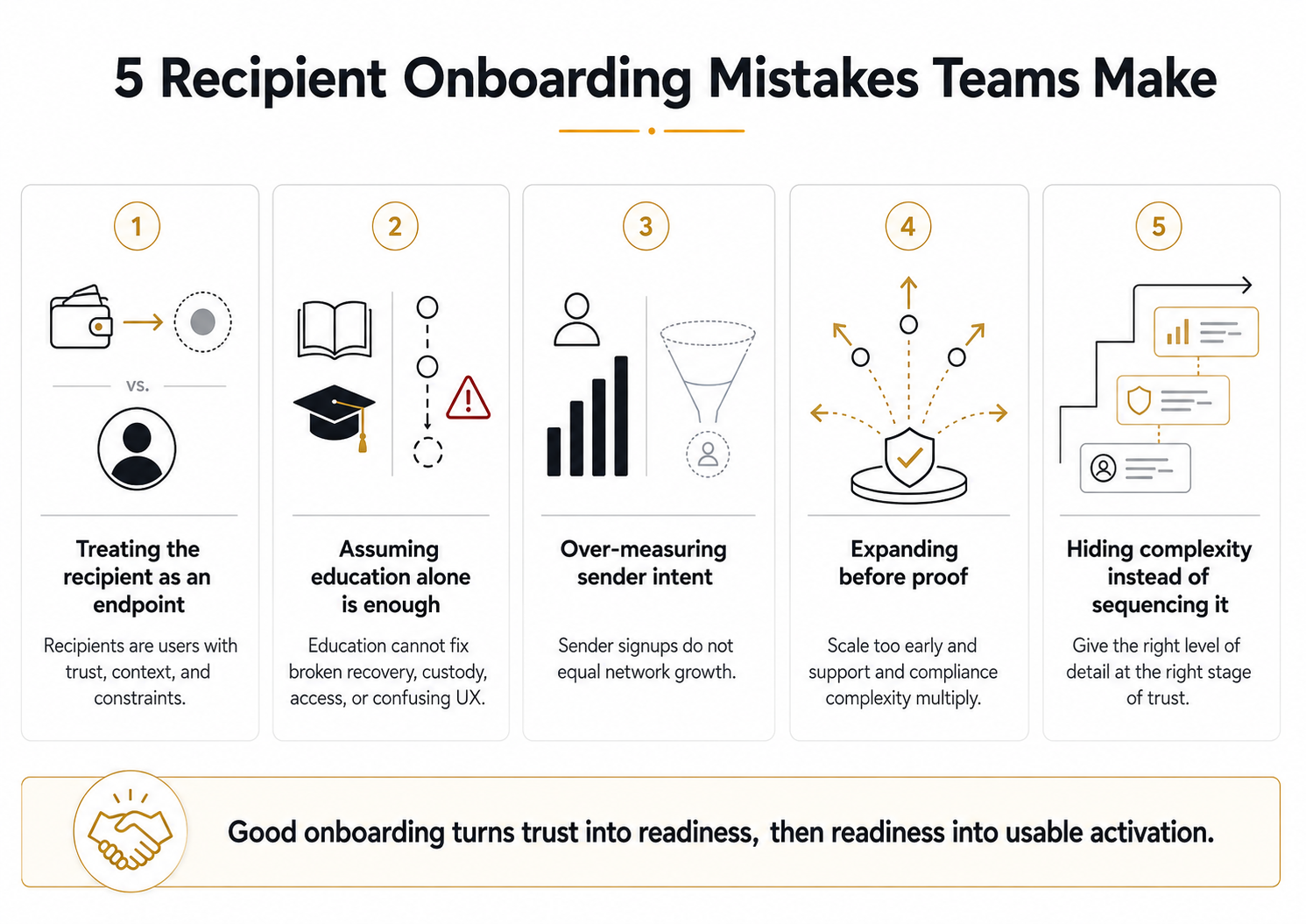
The first mistake is treating the recipient as a passive endpoint.
A recipient is not an address. A recipient is a user with trust concerns, context, habits, constraints, and alternatives. If the flow requires them to understand too much too quickly, they may not activate even when the payment rail works.
The second mistake is assuming education alone solves onboarding.
Education helps, but education cannot compensate for broken recovery, unclear custody, unsupported regions, poor off-ramp access, confusing fees, or a product interface that leaves the recipient unsure what just happened.
The third mistake is over-measuring sender intent.
Sender demand is important, but a payment network needs both sides. If the team celebrates sender signups while recipient completion stays weak, the funnel is producing interest rather than network growth.
The fourth mistake is expanding before proof.
A team may want to add more corridors, assets, chains, or use cases because it feels like scale. But expansion can multiply support load and compliance complexity if the first recipient workflow is not stable.
The fifth mistake is hiding crypto complexity instead of sequencing it.
Some recipients need simple language first. Others need technical clarity. The answer is not to hide material facts. The answer is to present the right level of detail at the right stage of trust.
How to measure success
Recipient onboarding and payment network effects should be measured with activation, retention, and commercial outcomes. Vanity metrics may diagnose awareness, but they do not prove network growth.
A practical measurement stack should include four layers.
Recipient readiness metrics
These show whether recipients can join the network.
- Recipient onboarding completion rate
- Time to recipient-ready
- KYC approval rate
- Wallet setup completion
- Recovery setup completion where relevant
- Supported-region eligibility
- Trust content engagement
- Support questions before first payment
First usable payment metrics
These show whether the first payment worked as an experience.
- First successful recipient payment
- Time from payment initiation to recipient confirmation
- Recipient comprehension signals
- Cash-out, reuse, transfer, or hold behavior where supported
- Failed-payment rate
- Support tickets per first payment
- Recipient confidence or satisfaction score
Network effect metrics
These show whether adoption is compounding across both sides.
- Active senders
- Active recipients
- Sender-recipient density by cohort or corridor
- Repeat sender rate
- Repeat recipient rate
- Second payment rate
- Referral or invitation behavior
- Corridor or marketplace expansion quality
Commercial metrics
These show whether the workflow connects to business outcomes.
- Cost per activated recipient
- Demo-to-pilot conversion
- Pilot-to-paid conversion
- Sales-cycle velocity
- Retention by payment use case
- Expansion revenue
- Qualified inbound from search, AI, LinkedIn, or referrals
- Founder, partner, or recruiter conversations generated by the proof base
The senior marketing lesson is that payment growth should not stop at “people clicked.” It should show whether the product moved users from hesitation to trust, from trust to activation, from activation to repeat usage, and from repeat usage to commercial proof.
Recipient onboarding does not mean every user needs the same flow
Not every recipient needs beginner-friendly handholding.
A crypto-native recipient may want network details, wallet compatibility, custody control, transaction hashes, supported chains, and technical documentation early. A mainstream recipient may need plain-language trust, simple receiving instructions, and reassurance that they can get help. A compliance-sensitive business recipient may need auditability, records, screening, policy language, and region-specific clarity.
The mistake is not choosing custodial or non-custodial, crypto-first or outcome-first, technical or simple.
The mistake is forcing every recipient through the same trust path.
Custody choice is especially important. Some recipients may prefer custodial flows because they reduce human error and recovery anxiety. Others may prefer self-custody because control is part of the value. Smart wallet and recovery models may reduce tradeoffs in some cases, but they still need clear communication.
For growth teams, custody is not only a technical architecture choice. It is a market-design variable that changes onboarding friction, trust, support burden, retention, and network expansion.
Commercial bridge
For wallets, exchanges, stablecoin companies, protocols, and crypto fintech teams, the practical question is not only:
“How do we get more people to try crypto payments?”
The better question is:
“What has to be true for both sides of the payment network to trust, activate, repeat, and create proof?”
That is where senior Web3/Crypto growth marketing becomes more than content. It becomes a system for aligning positioning, product experience, compliance clarity, lifecycle education, support, activation metrics, and commercial outcomes.
Recipient onboarding is one of the clearest places to see whether a team is building growth infrastructure or just running campaigns.
If the recipient cannot confidently receive, understand, and use the payment, the network effect never gets the chance to become real.
Web3 payment growth is not only a sender acquisition problem.
It is a recipient readiness problem.
The teams that win will not simply promote faster rails. They will build payment workflows where recipients can join with less friction, trust the process, complete the first usable payment, repeat the behavior, and create proof that attracts the next side of the network.
That is how recipient onboarding becomes a growth workflow.
And in Web3 payments, that workflow may be the difference between a transaction and a network.
Frequently Asked
Questions
What is recipient onboarding in Web3 payments? +
Recipient onboarding is the process of helping the person or business receiving a crypto or stablecoin payment understand, trust, access, and use the payment. It can include wallet setup, KYC, custody explanation, supported-region checks, fee clarity, security education, off-ramp guidance where available, and support.
Why does recipient onboarding matter for payment network effects? +
Payment networks are two-sided. Senders get more value when recipients can easily join and use the payment method. Recipients get more value when more senders pay through a reliable network. If recipient onboarding is confusing, expensive, or risky, cross-side network effects stall.
What is the best activation metric for Web3 payment recipients? +
A strong activation metric is the first usable payment. That means the recipient received the value, understood what happened, saw the funds in the expected interface, and could take the next useful action, such as holding, transferring, reusing, or cashing out where supported.
How does KYC friction affect Web3 payment growth? +
Repeated or unclear KYC can increase the fixed cost of recipient participation. If recipients verify repeatedly, wait too long, or provide information without understanding why, onboarding completion can fall. KYC reuse, clear expectations, and risk-based flows can reduce friction where they are legally and operationally appropriate.
Should Web3 payment teams use custodial or non-custodial onboarding? +
There is no universal answer. Custodial flows may reduce human error and recovery anxiety for some mainstream recipients. Non-custodial flows may appeal to users who value control. Smart wallet and recovery options may reduce tradeoffs in some contexts. The right choice depends on user segment, use case, compliance requirements, support capacity, and product promise.
What do crypto payment teams usually get wrong about recipient onboarding? +
They often treat recipients as passive endpoints, measure sender interest more than recipient activation, expand before proving one workflow, rely on education while ignoring product friction, or hide important crypto details instead of sequencing them properly.
How should Web3 payment teams measure network expansion? +
Teams should measure active senders, active recipients, repeat payment behavior, sender-recipient density, second transaction rate, corridor performance, recipient completion, support burden, pilot-to-paid conversion, and retention by use case. The goal is to prove that adoption is compounding across both sides of the network.
Does this apply only to stablecoin payments? +
No. Stablecoins are a strong example because many Web3 payment and payout use cases use them, but the workflow also applies to wallet payments, exchange payment flows, remittances, protocol rewards, creator payouts, contractor payments, merchant settlement, and other crypto fintech payment products.
Author note
Stefan Furcoi is a senior Web3/Crypto growth marketer focused on wallets, exchanges, protocols, and crypto fintech. His work connects positioning, trust, compliant education, activation, retention, content authority, and measurable business outcomes.
Article Disclaimer
The content of this article is provided for general informational purposes only and does not constitute financial, investment, legal or tax advice. StefanFurcoi.com makes no representations or warranties regarding the accuracy or completeness of the information, and it should not be relied upon without consulting qualified professionals. Any views expressed are subject to change and do not reflect any commitment to update the information. You are solely responsible for your decisions and should conduct your own research before acting on any information.