Crypto-native positioning strategies that actually survived market contact
Crypto-native positioning works best when protocols, DeFi products, tokenized asset platforms, and consumer Web3 brands turn technical features into clear market promises: lower friction, better trust, measurable efficiency, safer incentives, and useful ownership.


Crypto-native positioning
at a glance
The strongest crypto positioning does not sell “blockchain” as the promise. It turns the crypto mechanism into a clear business outcome: trust, activation, efficiency, retention, or usable ownership.
Infrastructure & Core Crypto
Position around fees, permanence, scalability tradeoffs, and governance clarity.
Evidence: Bitcoin fee-market behavior and governance-free stablecoin response.
Avoid generic “built on-chain” or “fully decentralized” claims without tradeoffs.
Measure: Transaction success, uptime, fee sensitivity, developer adoption.
DeFi
Lead with incentive clarity, risk controls, liquidity design, and user confidence.
Evidence: Concentrated liquidity testing, DeFi insurance research, peg behavior.
Avoid “better yield” claims without explaining risk, volatility, and user fit.
Measure: Retention, realized returns, TVL quality, claims conversion, repeat use.
RWAs & Physical Integration
Start with one high-friction workflow before promising full transformation.
Evidence: Supply-chain decision models and tokenized bond case studies.
Avoid “transform the industry” messaging before proving one useful process.
Measure: Cost savings, cycle time, reconciliation effort, pilot-to-paid conversion.
Gaming & Consumer Crypto
Reduce wallet friction and risk ambiguity before emphasizing token economics.
Evidence: GameFi adoption research shows risk concerns and high entry barriers.
Avoid leading with “earn” before proving fun, trust, safety, and simplicity.
Measure: Wallet setup, first session retention, repeat play, utility usage.
Utility NFTs & Loyalty
Position tokens around access, provenance, membership, identity, or service value.
Evidence: Digital twin experiments show NFTs can weaken premium product meaning.
Avoid novelty-first NFT messaging, especially where exclusivity matters.
Measure: Redemptions, access usage, loyalty retention, provenance interactions.
Token Launches & ICO-Like Markets
Make allocation, founder incentives, community alignment, and proof legible.
Evidence: ICO research shows ownership structure and social proof shape trust.
Avoid relying on followers, vague community claims, or unclear token logic.
Measure: Qualified participation, utility use, retention, governance activity.
Executive summary
Crypto-native positioning is not about saying “decentralized” louder.
Crypto products, protocols, and brands perform better when they translate technical architecture into a market promise users can understand, test, and trust. Across recent research on Bitcoin fee markets, DeFi stablecoin governance, concentrated liquidity, DeFi insurance, supply-chain blockchain adoption, tokenized bonds, GameFi adoption, utility NFTs, and ICO investor behavior, the strongest positioning strategies share one theme:
The market rewards crypto when the crypto layer solves a real coordination, cost, trust, liquidity, ownership, or access problem.
The weak version of crypto positioning says, “We are on-chain.”
The stronger version says, “Here is the friction we remove, the risk we reduce, the behavior we support, and the outcome we can measure.”
A positioning strategy should eventually show up in behavior, which is why the first successful transaction as a Web3 activation metric matters more than vanity attention.
That distinction matters now because Web3 is moving from novelty cycles into harder adoption questions. Infrastructure has to justify fees and scalability tradeoffs. DeFi has to prove risk management, not just yield. Tokenization has to prove operational value, not just digital ownership. Consumer crypto has to reduce onboarding friction and speculative ambiguity. Utility NFTs have to add meaning, access, provenance, or loyalty without weakening the product they are attached to.
For Web3 marketers and founders, the practical lesson is clear: position the outcome first, then explain the mechanism.
Direct answer
Market-tested crypto-native positioning strategies work when they connect blockchain-native features to measurable user or business outcomes. The strongest evidence points toward narrow wedge use cases, low-friction onboarding, clear incentive design, explicit governance tradeoffs, operational efficiency, credible risk controls, and utility-based ownership. Projects should avoid vague decentralization claims, novelty-first NFT messaging, generic “better yield” promises, and hype-driven social proof that is not backed by product reality.
What “market-tested crypto-native positioning” means
“Market-tested” does not always mean a perfect A/B test with millions of users.
In crypto, the evidence base is more uneven. Some findings come from on-chain behavior, protocol usage, fee-market data, back-testing, and real adoption responses. Some come from practitioner focus groups, expert evaluation, text mining, consumer experiments, and case-study analysis. That does not make the evidence useless. It means marketers and founders have to treat it with the right confidence level.
A market-tested positioning strategy is one where the message is not just a slogan. It has some observable support from user behavior, market response, operational evaluation, or consumer perception.
That can include:
- Users changing behavior after a protocol-level shock.
- Liquidity strategies performing differently under real market conditions.
- Enterprise blockchain strategies ranking differently under uncertainty.
- Tokenized bond prototypes reducing transaction-cost assumptions in expert evaluation.
- Consumers reacting negatively when an NFT-linked digital twin weakens perceived luxury.
- GameFi users revealing adoption blockers around risk, return, and entry friction.
- ICO investors responding more to social visibility and token ownership structure than to deeper team-quality signals.
In other words, there is no such thing as one universal crypto narrative that wins everywhere.
It tells us that the winning position depends on what the product is really selling: blockspace, liquidity, risk protection, settlement efficiency, ownership, community, access, or trust.
Why crypto-native positioning matters now
Crypto marketing has matured past the point where “on-chain” is enough.
A wallet team cannot rely on technical novelty if users hesitate at the first transaction. A DeFi protocol cannot rely on yield if the risk model is unclear. A tokenization platform cannot rely on the phrase “real-world assets” if the buyer cannot see reduced cost, faster settlement, cleaner reconciliation, or better compliance workflow. A gaming project cannot rely on token rewards if players see the experience as expensive, risky, or confusing.
The market is now asking harder questions:
What does the crypto layer actually improve?
What proof exists?
Where does the user hesitate?
What behavior should the positioning create?
What should product, compliance, growth, and community teams measure after the campaign goes live?
This is where crypto-native positioning becomes a growth function, not a branding exercise.
Positioning decides which promise the product makes to the market. Growth proves whether the market believed it.
What a broader research revealed across sectors
First, narrow and low-friction strategies are stronger than broad transformation claims. Blockchain adoption in Norwegian oil and gas, GameFi adoption research, and concentrated liquidity analysis all suggest that users and institutions respond better when complexity is reduced and the use case is clear.
Second, governance and incentives are not secondary. They are part of the product’s market identity. Liquity’s governance-free design, DeFi insurance bottlenecks, concentrated liquidity design, and ICO ownership patterns all show that crypto users respond to incentive architecture, not just front-end messaging.
Third, tokenization works best when it solves an operational problem incumbents already feel. Bond-market tokenization and supply-chain blockchain research support positioning around transaction-cost reduction, settlement, reconciliation, uncertainty reduction, and sustainability rather than generic “innovation.”
Fourth, consumer crypto needs more careful positioning than most Web3 teams assume. GameFi adoption research shows that users worry about risk, returns, and entry barriers. Utility NFTs market reveal that digital twins can weaken luxury perception when the token changes the meaning of the physical product.
That gives us a useful strategic rule:
Crypto-native positioning works when the technical feature becomes a credible market promise. It fails when the technical feature is treated as the promise itself.
1. Infrastructure and core crypto: position around constraints, not ideology
Infrastructure marketing often falls into the “bigger, faster, cheaper, more decentralized” trap.
The problem is not that those ideas are irrelevant. The problem is that infrastructure users do not experience blockchains as slogans. They experience fees, latency, failed transactions, bridging friction, governance risk, composability, and uncertainty about where to build.
Fee-market positioning
A product built on Bitcoin’s base layer must treat fees and blockspace demand as strategic variables, not background details.
The finding that inscription activity related differently to fee rates than regular transactions points to a deeper positioning issue: not every use case belongs directly on the most expensive, scarce, permanent layer at every moment.
For marketers and founders, this creates a direct decision rule:
If permanence is the reason your product is valuable, L1 positioning may work. If low-cost repeat interaction is the reason your product is valuable, L2, off-chain, or hybrid positioning may be more credible.
A Bitcoin-native product should not simply say “built on Bitcoin.” It should explain why Bitcoin-level permanence, settlement assurance, cultural alignment, or security matters enough to justify the tradeoff.
L1/L2 design and scalability positioning
Layer-1 and Layer-2 positioning should also avoid generic scalability claims.
The better strategy is segmentation:
- Builders care about throughput, developer tooling, composability, uptime, and ecosystem access.
- Users care about fees, speed, safety, and whether the transaction did what they expected.
- Institutions care about finality, compliance workflows, operational reliability, and risk controls.
- Ecosystem partners care about liquidity, incentives, grants, distribution, and developer mindshare.
That means infrastructure positioning should be built around the user’s constraint.
A consumer wallet does not need to explain every consensus tradeoff to a beginner. A protocol ecosystem does need to explain why builders should deploy there instead of somewhere else. A payments app needs to explain reliability, settlement, and fee predictability before it talks about ideology.
Governance as positioning
Governance minimization can position a protocol as credible, predictable, and resistant to capture. But if a competitor changes the user’s expectations around yield, peg dynamics, capital efficiency, or product flexibility, the same governance-free design can become rigid.
This is one of the most important positioning lessons in crypto:
Do not market immutability as an absolute virtue unless the product can remain competitive under changing market conditions.
A protocol should be honest about its governance philosophy. If it is immutable, explain what users gain and what they give up. If it is adaptable, explain how changes are governed, constrained, communicated, and protected from abuse.
The best infrastructure positioning does not pretend tradeoffs do not exist. It makes the tradeoff legible.
2. DeFi: position around incentive clarity, risk controls, and user confidence
DeFi positioning has often over-indexed on yield.
That worked during hype cycles because yield is easy to market. It is also dangerous because it can attract the wrong user expectations.
A better DeFi positioning model could be to: explain the incentive system, the risk model, the liquidity design, and the user outcome.
Concentrated liquidity: capital efficiency is not universal superiority
Concentrated liquidity compared to unbounded liquidity, and grid strategies using Ethereum data in many instances has showed that “concentrated liquidity always wins.”
This sector is more nuanced because performance depends on price behavior and strategy regime.
That matters for positioning.
A DeFi protocol or LP-facing product should not make blanket “better yield” claims. It should position concentrated liquidity as a regime-aware capital-efficiency tool.
A stronger message would sound like this:
“Concentrated liquidity can improve capital efficiency when liquidity providers understand price ranges, volatility regimes, and active management requirements.”
That is less flashy. It is also more credible.
The market-tested positioning lesson is that DeFi products should segment by user sophistication. A professional LP, market maker, or DeFi-native trader can handle range strategy language. A retail user may need a much clearer explanation of risk, impermanent loss, position management, and the difference between displayed yield and realized outcome.
DeFi: trust is a bundled product
In the DeFi sector, crypto-native adoption is especially useful because it shows that the category’s challenge is not simply awareness. The bottlenecks include liquidity, actuarial design, claims verification, scale, yield, exploitation, cybersecurity, and regulation.
That means DeFi insurance cannot position itself as a simple “cover marketplace.”
The credible position is a bundled trust layer:
- Where does capital come from?
- How are risks priced?
- How are claims verified?
- What is covered?
- What is excluded?
- How are exploits, oracle problems, and governance attacks handled?
- What happens when a large correlated loss event occurs?
- How does the model remain sustainable?
The marketing implication is direct:
In DeFi insurance, trust is not a brand tone. It is product architecture.
A DeFi insurance brand should not lead with “peace of mind” unless it can show the mechanism behind that peace. The positioning should connect coverage design, liquidity sourcing, verification, cybersecurity, and claims logic into one understandable promise.
Stablecoins and DeFi lending: position around reliability before growth
Stablecoins, lending protocols, and synthetic yield products face a similar challenge.
Users do not only ask, “What can I earn?” They also ask, “What can break?”
The Liquity tied market suggests that peg deviations, collateralization behavior, and exit probability can become adoption signals. When a competitive shock changes the market, users respond. That means stablecoin positioning should make risk and mechanism design visible before the market forces users to discover it under pressure.
For lending protocols, the same logic applies to liquidation design, collateral assets, oracle dependencies, utilization, liquidity depth, and risk parameters.
The strongest DeFi positioning is not anti-growth. It is pro-survival.
The best message is not “maximum yield.”
It is closer to:
“Here is the user this product is designed for, the risk it helps manage, the conditions where it performs well, and the conditions where users should be careful.”
That kind of clarity may not attract the fastest speculative traffic. It attracts better-fit users, better retention, and fewer trust-destroying surprises.
Stablecoin teams face the same positioning problem: they need to know when to lead with crypto and when to lead with the payment outcome. I covered that decision rule in this breakdown of stablecoin marketing strategy
3. Real-world and physical integration: position around operational pain, not blockchain excitement
Real-world asset and enterprise blockchain teams often make a predictable mistake.
They sell the technology before they prove the operational pain.
But enterprise buyers rarely wake up thinking, “I need more blockchain.” They think, “Settlement is slow.” “Reconciliation is expensive.” “Data handoffs are messy.” “Audit trails are fragmented.” “Counterparty processes are inefficient.” “Compliance review is heavy.” “Carbon reporting is getting harder.” “Our current workflow is full of manual uncertainty.”
This is where tokenization and physical integration can win.
Supply chain: single-use beats “transform everything”
A Norwegian oil-and-gas blockchain study found that under uncertainty, “Single Use” ranked strongest, with “Substitution” also performing well in several models.
That result should be printed on a sticky note in every enterprise blockchain GTM room.
The market does not need another “blockchain will transform the whole industry” pitch. It needs one painful workflow where blockchain can reduce uncertainty, coordination cost, verification burden, or settlement friction.
The better strategy is:
Start with one high-friction process. Prove the operational improvement. Then expand.
That applies to supply chain, compliance, payments, trade finance, tokenized assets, and enterprise settlement.
A practical positioning sequence would be:
- Identify the process where trust, reconciliation, or handoff friction is expensive.
- Position blockchain as a substitution for that specific pain.
- Prove cost, cycle-time, audit, or error reduction.
- Use the proof to expand into adjacent workflows.
The market-tested lesson is simple: narrow beats grandiose when uncertainty is high.
Tokenized bonds: sell transaction-cost reduction, not “future of finance”
The tokenized bond-market design is a strong example of practical tokenization positioning. The prototype was evaluated around transaction-cost reduction, fewer intermediaries, reduced reconciliation burden, lower uncertainty, and workflow simplification.
That is the right narrative.
A tokenized bond platform should not lead with “we are reinventing capital markets” unless the buyer already agrees that reinvention is the goal. Most buyers want efficiency, resilience, compliance clarity, and operational improvement.
The stronger position is:
“Tokenization can simplify issuance, ownership records, servicing, settlement logic, and reconciliation when the workflow is designed around real market participants.”
That is more credible to issuers, institutions, and fintech operators.
Tokenized bonds and sustainability: cost plus carbon is a stronger institutional story
For institutional markets, sustainability should not be decorative. It should be tied to a specific operational claim. If a tokenized asset platform can show lower process burden and a more efficient environmental profile under proof-of-stake infrastructure, that becomes a stronger enterprise positioning wedge.
The key is not to overstate it.
The responsible message is not “tokenization is automatically green.”
The better message is:
“Under the right infrastructure and workflow design, tokenization may reduce certain operating costs and support a more efficient process profile. Teams should measure the actual cost, energy, and operational impact rather than assuming it.”
That is the difference between credible institutional positioning and crypto theater with a sustainability costume.
4. Culture, gaming, and consumer crypto: position around meaning, friction, and user psychology
Consumer crypto is where many technically correct products lose the plot.
A protocol can be elegant. A wallet can be secure. A game can have token rewards. A loyalty program can have NFTs. None of that guarantees adoption if the user does not understand the value, trust the experience, or feel that the crypto layer improves the product.
Trust is not a slogan in crypto. It is product architecture, risk explanation, compliance posture, support, and proof — the same logic behind stablecoin trust center marketing
GameFi: lower risk ambiguity before selling ownership
In GameFi adoption shows that users see the category as early-stage, worry about risk and return, and face high entry barriers.
This creates a strong positioning lesson:
GameFi should not lead with earning before it proves play, safety, and simplicity.
If the first message is “earn tokens,” the product attracts financially motivated users and triggers skepticism among mainstream gamers. If the first message is “play a better game with optional ownership and portable value,” the product has a better chance of sounding like a game rather than a financial task wearing game clothes.
GameFi positioning should answer:
- Is the game fun without the token?
- What does ownership improve?
- What does the user risk?
- How hard is wallet setup?
- Can users participate without understanding every crypto mechanic?
- Are rewards sustainable or dependent on constant new entrants?
- What happens if token prices move?
The strategic challenge is not to hide crypto. It is to sequence it.
The user should understand the experience first, then the ownership layer, then the economic layer.
Loyalty and consumer crypto: utility has to be felt, not announced
For consumer brands, crypto utility should be positioned around familiar benefits:
- Access.
- Membership.
- Rewards.
- Identity.
- Status.
- Provenance.
- Portability.
- Community participation.
- Service continuity.
The mistake is assuming users care that the benefit is tokenized.
Most users care that the benefit works, feels valuable, and does not create new anxiety. A loyalty NFT that adds confusing wallet steps, tax questions, security risk, or resale speculation may reduce trust instead of increasing engagement.
The right positioning is not “NFT loyalty.”
It is:
“Members get verifiable access, portable benefits, and a clearer relationship with the brand.”
Then the product can explain how the token supports that experience.
Utility NFTs: digital twins can weaken premium meaning
NFT-linked digital twins can reduce responses to physical luxury products when they lower perceived luxuriousness.
This does not mean utility NFTs are bad.
It means the token changes the meaning of the product.
In luxury, scarcity, craft, distance, and exclusivity matter. If the digital twin makes the product feel copied, gamified, or over-explained, the positioning can backfire. In other categories, digital twins may work well for provenance, service history, warranty, access, or authenticity. But premium brands must test whether the token enhances the object or dilutes it.
The strongest utility NFT positioning is category-specific:
- For luxury: provenance, authentication, private access, service history.
- For events: ticketing, access, anti-fraud, loyalty history.
- For gaming: item ownership, portability, player identity, optional marketplace access.
- For commerce: warranty, membership, rewards, resale verification.
- For creators: gated access, membership continuity, proof of support.
The lesson is not “use NFTs.”
The lesson is “know what the token does to the meaning of the customer relationship.”
ICO evidence: token ownership and social proof reveal how crypto audiences interpret signals
Although ICOs are not the same as modern protocol launches, ICO ownership and social media still gives Web3 marketers valuable signals about crypto-native audiences.
Ownership structure sends different messages to different audiences
In ICO ownership two-audience problems appear:
Market-oriented investors may interpret founder ownership as “skin in the game.”
Community-oriented investors may interpret broad distribution as ideological alignment with decentralization.
This is one of the most useful positioning insights for token projects:
The same token structure can signal credibility to one audience and misalignment to another.
A high founder allocation can reassure market-oriented investors that the team remains committed. It can also trigger concerns about centralization, governance capture, or future dumping. Broad distribution can reassure community-oriented users that the project aligns with decentralization. It can also trigger concerns about lack of founder commitment if the rationale is not clear.
The positioning implication is not that one ownership model always wins. It is that token design must be explained according to the audience it is meant to serve.
A token project should clarify:
- Who needs to trust the allocation?
- What behavior should the allocation encourage?
- How are insiders constrained?
- How does governance work?
- What is the lockup or vesting logic?
- How does the structure support the product’s long-term health?
Tokenomics is not just economics. It is market communication.
Followers can beat substance in early crypto markets, but that is not a healthy positioning strategy
From a generalized ICO social media point of view, follower counts and team sizes still stand out and for a crypto-native positioning in 2026 it's still known to be one of the most significant factors for reaching soft caps than management education or skills.
That finding is uncomfortable, but useful.
It shows that social proof can move investor behavior even when it does not reduce information asymmetry. In early crypto markets, visible popularity can act as a shortcut for perceived credibility. That may help a campaign raise money, but it is a weak foundation for long-term trust.
For modern Web3 teams, the lesson is not “buy followers.”
The lesson is:
Visibility matters, but visibility without proof creates fragile trust.
Founders and marketers should build distribution, but not as a substitute for product evidence. Social proof should point to proof, not replace it.
A healthier version of this strategy is:
- Use social channels to explain the mechanism.
- Show evidence of usage, retention, integrations, audits, pilots, or customer outcomes.
- Make team credibility visible in plain language.
- Avoid over-reliance on follower counts, vanity engagement, and hype loops.
- Use community as a feedback system, not only a megaphone.
Crypto markets may reward attention quickly. Sustainable positioning has to convert attention into trust, activation, and repeat behavior.
For wallets, exchanges, protocols, and crypto fintech teams that need to turn trust into activation, a Web3 Trust & Activation Audit can help identify where positioning, onboarding, proof, and conversion are leaking.
Comparison: common successful strategies across sectors
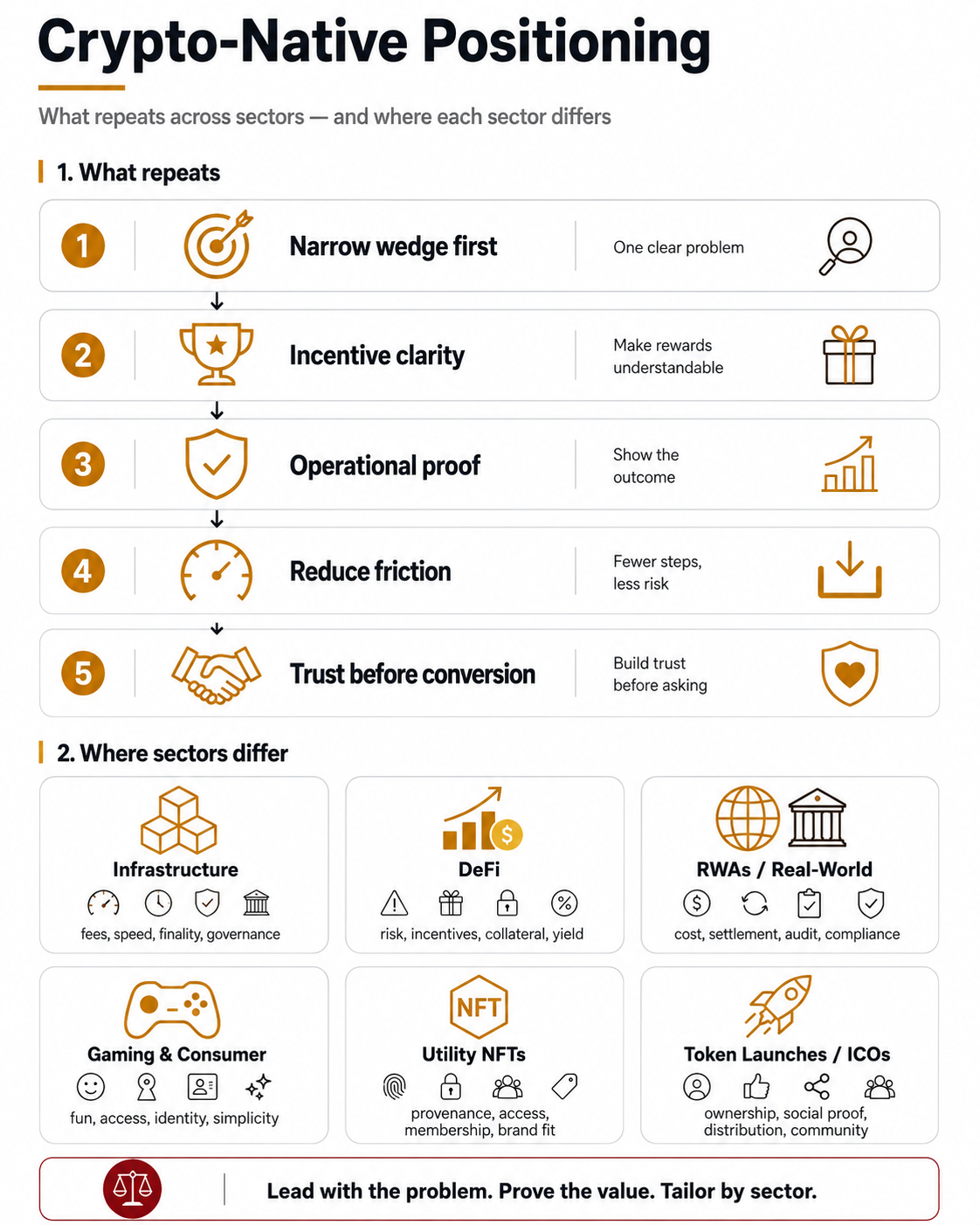
Across infrastructure, DeFi, RWAs, consumer crypto, gaming, and utility NFTs, several strategies repeat.
1. Narrow wedge before broad transformation
The most credible projects start with a specific user problem.
Infrastructure can start with a specific developer or transaction pain. DeFi insurance can start with a specific coverage problem. Tokenized bonds can start with issuance and reconciliation. Supply chain can start with one high-friction process. GameFi can start with reducing entry friction for one player segment.
The market trusts focus before it trusts scale.
2. Incentive clarity before community hype
Crypto products are incentive systems. If the incentive design is unclear, marketing will not fix it.
That applies to governance, liquidity, stablecoins, lending, insurance, games, loyalty, and token allocations. The strongest positioning makes incentive logic understandable.
3. Operational proof before ideological language
“Decentralized” is not enough.
A buyer needs to know what improves. Faster settlement? Lower fees? Better audit trail? More transparent collateral? Easier access? Reduced reconciliation? Stronger provenance? Better retention loop?
Crypto-native positioning must translate ideology into proof.
4. Friction reduction before feature expansion
Users do not adopt more complexity just because the team is excited about it.
GameFi adoption blockers, wallet friction, DeFi risk ambiguity, and enterprise uncertainty all point to the same practical issue: adoption often improves when the product removes steps, explains risk, and narrows the first action.
5. Trust architecture before conversion pressure
Trust is not a headline. It is the sum of product design, risk explanation, user education, compliance posture, support, transparency, and proof.
A growth funnel that asks for action before trust is built will often produce weak activation, high support burden, and poor retention.
Comparison: where strategies differ by sector
The common patterns are useful, but sector differences matter.
Infrastructure positioning is about technical tradeoffs becoming strategic benefits. Fees, throughput, finality, governance, security, and developer ecosystems matter. The audience often includes builders, protocols, institutions, and power users.
DeFi positioning is about risk-adjusted confidence. Liquidity design, collateral mechanics, incentives, yield sustainability, oracle dependencies, and governance matter. The audience may be sophisticated, but even sophisticated users need clear risk framing.
Real-world integration positioning is about operational improvement. Buyers care about cost, settlement, reconciliation, compliance, auditability, workflow efficiency, and commercial implementation.
Gaming and consumer crypto positioning is about experience and psychology. Users care about fun, access, identity, trust, simplicity, status, and whether the crypto layer makes the experience better or weirder.
Utility NFT positioning is about meaning. The same token can signal provenance in one category and cheapen the product in another. Premium brands need more caution than open gaming economies.
ICO and token launch positioning is about signal interpretation. Ownership, social proof, team size, community structure, and token distribution send messages that different audiences read differently.
Practical takeaways for Web3 marketers, founders, and product teams
The market-tested evidence points toward a more disciplined way to build crypto-native positioning.
Build the positioning from the user’s real hesitation
Every sector has a different hesitation.
For infrastructure, the hesitation may be fees, reliability, tooling, or ecosystem risk.
For DeFi, it may be loss, liquidation, exploit risk, yield sustainability, or governance capture.
For RWAs, it may be legal clarity, operational integration, settlement process, or institutional trust.
For GameFi, it may be wallet setup, token volatility, entry cost, or whether the game is actually fun.
For loyalty and utility NFTs, it may be whether the token adds value or makes the brand experience feel less premium.
Strong positioning starts where hesitation lives.
Turn mechanism into promise
A mechanism is a technical feature.
A promise is what the user gets.
“Concentrated liquidity” is a mechanism. “Better capital efficiency for active LPs in suitable price regimes” is a promise.
“Tokenized bonds” is a mechanism. “Lower reconciliation burden and more efficient settlement workflows” is a promise.
“NFT digital twin” is a mechanism. “Verifiable provenance and service access without weakening brand meaning” is a promise.
“Governance-free protocol” is a mechanism. “Predictability with explicit adaptability tradeoffs” is a promise.
The marketer’s job is not to decorate the mechanism. It is to translate it.
Separate strong evidence from early evidence
Some findings are stronger than others.
On-chain fee-market behavior, real protocol responses, consumer experiments, and large ICO datasets provide stronger behavioral signals. Prototype evaluations, practitioner focus groups, text mining, and single-case studies are useful but should be treated as directional.
This distinction matters in public writing and GTM strategy. Do not overclaim. Say what the evidence supports, where it is early, and what the team should test next.
Credibility compounds when the market sees that you know the difference.
Position against bad alternatives, not abstract competitors
The best positioning often wins by replacing a painful alternative.
For RWAs, the bad alternative may be manual reconciliation.
For supply chain, it may be fragmented coordination.
For DeFi insurance, it may be uncovered smart-contract risk.
For GameFi, it may be clunky wallet onboarding and speculative ambiguity.
For infrastructure, it may be expensive or unreliable transaction execution.
For utility NFTs, it may be unverifiable access, weak loyalty continuity, or poor provenance.
Positioning should make the before-and-after visible.
Measure the behavior the positioning is supposed to change
A positioning strategy is not proven by applause.
It is proven when the target user behaves differently.
Useful metrics include:
- First successful transaction.
- Time to first action.
- Second transaction rate.
- Repeat usage.
- Retention by cohort.
- LP strategy adoption by user segment.
- Support tickets per activated user.
- Trust-center engagement.
- Claims completion or coverage conversion.
- Pilot-to-paid conversion.
- Sales-cycle velocity.
- Cost or cycle-time reduction.
- Qualified inbound from target buyers.
- Community participation quality.
- Token utility usage, not only token volume.
The right metric depends on the promise.
If the promise is lower friction, measure time and completion.
If the promise is trust, measure objections, support burden, and repeat behavior.
If the promise is operational efficiency, measure cost, delay, reconciliation, and process reliability.
If the promise is ownership, measure actual utility usage, not just resale interest.
What marketers and founders should avoid
Avoid using “decentralized” as a substitute for explaining governance.
Avoid saying “better yield” without explaining risk, volatility regime, liquidity conditions, and user fit.
Avoid pitching enterprise blockchain as total transformation before proving one valuable workflow.
Avoid positioning tokenization as innovation when the buyer needs cost, settlement, reconciliation, or compliance improvement.
Avoid adding NFTs to premium products without testing whether they improve or weaken perceived value.
Avoid leading consumer crypto with speculation when the user still does not trust the product experience.
Avoid treating social proof as proof of quality.
Avoid hiding tradeoffs. Crypto users eventually find them. Usually at the worst possible time.
Strategic framework: The Crypto-Native Positioning Proof Stack
Here's a practical framework for crypto teams:
Wedge → Mechanism → Trust → Activation → Proof → Expansion
Wedge
Start with one market problem.
Not “bring finance on-chain.”
Instead: reduce bond settlement friction, improve LP capital efficiency for active users, lower GameFi onboarding barriers, verify product provenance, or make stablecoin risk easier to understand.
The wedge is the first believable use case.
Mechanism
Explain what the crypto layer does.
This may be tokenization, smart contracts, decentralized governance, concentrated liquidity, on-chain settlement, digital ownership, or verifiable provenance.
The mechanism should never be the whole story. It should support the user promise.
Trust
Show why the user should believe it.
Trust can come from audits, transparent risk models, clear fee logic, claims processes, governance constraints, compliance-aware education, case studies, user flows, or measurable operational improvements.
In Web3, trust is not a mood. It is infrastructure.
Activation
Define the first meaningful action.
For a wallet, that may be a first successful transaction.
For a DeFi protocol, it may be a first deposit that the user understands.
For a tokenized bond platform, it may be a completed pilot workflow.
For GameFi, it may be a first play session without wallet confusion.
For loyalty, it may be a redeemed benefit.
Proof
Measure whether the promise worked.
Proof should connect to the promise. If the promise is efficiency, show efficiency. If the promise is lower friction, show completion. If the promise is confidence, show repeat behavior and reduced support burden.
Expansion
Scale only after the wedge proves itself.
This is where many crypto teams reverse the order. They attempt expansion before proof. The stronger path is narrower, more disciplined, and more measurable.
How Web3 teams can apply this in practice
A practical 30-day positioning sprint could look like this.
First, map the current market promise. Write down what the project claims to improve. Then remove every phrase that could apply to 500 other crypto projects.
Second, identify the actual user hesitation. Interview users, review support tickets, analyze drop-off points, study community questions, and look at failed activation moments.
Third, classify the product’s strongest evidence. Is it behavioral, operational, experimental, expert-reviewed, on-chain, or still only a hypothesis?
Fourth, rewrite positioning around the strongest proven promise. If the best evidence is cost reduction, lead with cost. If the best evidence is reduced friction, lead with friction. If the best evidence is trust, lead with trust. If the best evidence is community alignment, explain the governance and allocation logic.
Fifth, choose one activation metric. Do not let the team hide behind impressions, signups, or token volume. The metric should prove the positioning moved the user toward meaningful product value.
Sixth, build the proof loop into the content system. Case studies, explainers, onboarding pages, trust centers, FAQs, product emails, sales collateral, and community posts should all reinforce the same promise.
That is how positioning becomes a growth system instead of a homepage exercise.
Nuance: crypto-native does not mean crypto-first in every message
There is a difference between being crypto-native and forcing crypto language into every buyer conversation.
A DeFi-native audience may want technical detail early. A stablecoin infrastructure buyer may want payment reliability before chain architecture. A gamer may want gameplay before token mechanics. A luxury buyer may want provenance without being dragged into NFT vocabulary. An institutional RWA buyer may want workflow efficiency before ideology.
Crypto-native positioning means the strategy respects the crypto mechanism.
It does not mean every sentence starts with the mechanism.
The better rule is:
Lead with the outcome the audience already values. Explain the crypto layer when it increases trust, clarity, or differentiation.
Practical takeaways by team type
For founders
Do not position your product around the feature you are proudest of. Position it around the friction the market already feels. Then prove why your crypto architecture solves that friction better than the alternatives.
For marketers
Stop treating content as a translation layer after product decisions are finished. In crypto, marketing needs to understand tokenomics, incentives, governance, risk, compliance, UX, and user behavior. Otherwise the messaging will either overpromise or miss the real value.
For product teams
Positioning should expose product gaps early. If users do not trust the mechanism, the issue may not be copy. It may be onboarding, risk disclosure, support, governance design, or incentive clarity.
For ecosystem builders
Do not market the ecosystem only through total value locked, grant size, or partner logos. Show who builds, why they stay, what use cases work, where liquidity is useful, and how the ecosystem reduces friction for specific participants.
For wallet and exchange teams
Education is useful, but education alone does not equal activation. Connect education to the first successful action, second action, repeat use, and support reduction.
For RWA and enterprise teams
The strongest message is operational. Talk about cost, settlement, reconciliation, auditability, compliance workflow, and implementation risk. “Blockchain” should support that story, not replace it.
Commercial bridge
For wallets, exchanges, protocols, DeFi teams, tokenization platforms, and crypto fintech companies, the practical question is not only “How do we explain the product?”
The better question is:
Where does the user hesitate, what proof do they need, and how should positioning turn trust into activation, retention, and measurable business outcomes?
That is where crypto marketing becomes senior growth work. It connects narrative, product reality, user behavior, compliance sensitivity, and revenue-aligned outcomes.
Conclusion: the market does not reward crypto features. It rewards crypto features that solve something.
The research across crypto sectors points to one strategic insight:
Crypto-native positioning works when it makes the invisible value of the protocol visible to the market.
Infrastructure has to make tradeoffs legible. DeFi has to make incentives and risks understandable. Tokenization has to make operational improvement measurable. Consumer crypto has to make utility feel natural. Utility NFTs have to strengthen the relationship between product, brand, and user. Token launches have to make ownership and governance signals credible to the audience they want to attract.
The mistake is thinking the market needs more crypto language.
Most of the time, the market needs clearer proof.
A strong crypto-native position does not hide the blockchain layer. It puts it in the right place: behind a concrete promise, supported by a credible mechanism, measured by real behavior, and explained in language the user can act on.
That is how Web3 teams move from hype to trust.
And trust is where growth starts to become durable.
Frequently Asked
Questions
What are crypto-native positioning strategies? +
Crypto-native positioning strategies explain a crypto product’s value by connecting blockchain-native features to real user or business outcomes, such as lower friction, clearer ownership, better liquidity design, improved trust, verifiable access, or more efficient settlement.
What crypto positioning strategies appear to work best? +
The strongest patterns are narrow wedge use cases, low-friction onboarding, clear incentive design, explicit governance tradeoffs, operational-efficiency messaging, credible risk controls, and utility-based ownership. The right strategy still depends on the sector and user segment.
How should infrastructure and protocol teams position themselves? +
Infrastructure and protocol teams should position around concrete tradeoffs such as fees, speed, finality, developer experience, scalability, governance, and security. Generic decentralization claims are weaker than explaining which user problem the architecture solves.
How should DeFi products position themselves? +
DeFi products should position around incentive clarity, risk controls, liquidity design, collateral mechanics, and user confidence. Yield can be part of the story, but it should not replace transparent risk education and clear user-fit messaging.
What is the strongest positioning strategy for tokenized real-world assets? +
Tokenized RWA teams should lead with operational value: lower transaction costs, faster settlement, better reconciliation, clearer audit trails, reduced uncertainty, or improved workflow efficiency. Tokenization should support the business case, not replace it.
What should GameFi and consumer crypto teams avoid? +
GameFi and consumer crypto teams should avoid leading with speculation before proving user experience, simplicity, safety, and non-speculative value. If users see the product as risky or confusing, token rewards may increase skepticism instead of adoption.
Do utility NFTs work as a positioning strategy? +
Utility NFTs can work when they provide access, loyalty, provenance, identity, ticketing, membership, or service value. They can backfire when they are added only for novelty or when they weaken the meaning of the original product, especially in premium categories.
How can crypto projects position themselves without hype? +
Crypto projects can avoid hype by leading with the user problem, explaining the mechanism clearly, naming the tradeoffs, supporting claims with evidence, and measuring outcomes such as activation, repeat usage, cost reduction, retention, or qualified adoption.
Author Bio
Stefan Furcoi is a senior Web3/Crypto growth marketer focused on wallets, exchanges, protocols, and crypto fintech. His work connects positioning, trust, compliant education, activation, retention, content authority, and measurable business outcomes.
Article Disclaimer
The content of this article is provided for general informational purposes only and does not constitute financial, investment, legal or tax advice. StefanFurcoi.com makes no representations or warranties regarding the accuracy or completeness of the information, and it should not be relied upon without consulting qualified professionals. Any views expressed are subject to change and do not reflect any commitment to update the information. You are solely responsible for your decisions and should conduct your own research before acting on any information.