Crypto education is not enough: how wallets turn understanding into action
A user can understand crypto and still fail at the exact moment a wallet asks for action. This research-backed article shows how wallet teams can turn education into safe first value, repeat utility, and measurable growth.


Executive summary
A user can understand what a recovery phrase is, explain why network fees exist, and pass a quiz on token approvals but then freeze when a wallet asks for a real signature.
That is not a contradiction. It is the difference between knowing and doing.
Crypto education can improve awareness, perceived usefulness, and intention. What it cannot prove on its own is whether a user can choose the right route, recognize the consequence of an authorization, complete a useful transaction, find the result, return for a second action, or recover control when the normal journey breaks.
Wallet teams often measure the part of the journey that content can see: views, lesson completion, quiz scores, clicks, and stated confidence. The user and business outcomes arrive later, when that knowledge meets custody, fees, addresses, permissions, accessibility constraints, irreversible actions, and the possibility of loss.
The process points toward a more complete operating model. Education should build the mental model. Positioning should connect it to a job the user already values. Product design should make the next step executable. Contextual safeguards should improve the decision while it can still change. Measurement should show whether the user reached safe first value, returned, and remained capable of recovery or revocation.
For crypto wallet teams, education is not the finish line. It is the first layer of an activation system.
Article Brief
From crypto knowledge
to wallet behavior
| Reader problem | Education completion can rise while safe wallet activation and repeat use remain flat. |
|---|---|
| Core argument | Understanding becomes action only when usable design, contextual trust, appropriate defaults, and timely intervention carry the user through the decision. |
| Framework | Understand → See Value → Trust Enough → Feel Capable → Act Safely → Repeat → Recover. |
| Business outcome | More safe first value, stronger repeat utility, lower avoidable support burden, and clearer revenue-aligned growth measurement. |
| Strategic warning | Awareness, stated intent, wallet creation, and raw transaction volume are signals—not proof of durable adoption. |
Direct answer
Short answer: Crypto education is necessary but insufficient because it changes what users understand more reliably than it changes what they safely complete and repeat. Wallets turn understanding into action by pairing job-specific education with contextual guidance, transparent custody and consequences, accessible controls, appropriate defaults, risk-sensitive intervention, clear confirmation, and behavioral measurement.
The practical standard is not “Did the user learn?” It is: Did the user apply the right knowledge to the right action, receive the expected value, understand what happened, and remain capable and confident enough to return?
Who this matters for
This matters most for crypto wallet teams that already publish useful educational content yet still watch users stall at setup, funding, recovery, signing, or repeat use. Growth and product marketing may see the gap first, but they cannot close it alone. Product, UX, security, analytics, support, and compliance all shape whether knowledge survives the next decision.
For founders, operators, recruiters, and investors, the distinction also improves diligence. A company making strong claims about crypto education and wallet activation should be able to show how learning connects to safe first value, retained behavior, support demand, and sustainable economics—not only traffic, course completion, or projected intention.
The lesson ends exactly where the financial decision begins
Imagine a new self-custody user who completes a short course on recovery phrases, network fees, and token approvals. The learning dashboard turns green. The quiz says they understand.
Then the wallet asks them to choose a network, evaluate a shortened address, interpret a fee in an unfamiliar unit, and authorize a contract with a broad spending allowance. The calm lesson has become a live financial decision. The user hesitates—or focuses on the token they expect to receive and misses what the approval permits.
Nothing about that moment makes the education useless. It reveals its boundary.
The course created a mental model. The wallet still has to make that model usable when the consequence is real. If the lesson says one thing and the interface makes another thing easier, the interface usually wins.
This is the territory beyond the broader principle that wallet growth depends on trust before activation. Trust may earn the next click. It does not automatically give the user the capability to complete the next financial action correctly.
That handoff is where crypto education becomes product growth—or remains content consumption with a respectable completion rate.
Why this matters now: education changes the mind before it proves behavior
Adoption research often places awareness, usefulness, ease of use, trust, and intention inside the same model. That is useful for explaining why a person may become more open to cryptocurrency. It becomes dangerous only when a growth team compresses those constructs into one triumphant label: adoption.
A 2024 study of 332 respondents found that awareness was positively associated with its cryptocurrency “adoption” construct, with ease of use, usefulness, and trust playing important roles. The methodological detail matters: the construct represented respondents' projected likelihood of adopting, not verified wallet creation, funding, safe transaction completion, or retention (Shahzad et al., 2024).
That does not weaken the study. It clarifies what the evidence can support.
Awareness and intention are leading indicators. They can tell a team that the user may see value and feel more open to the product. They cannot tell the team whether the user reached the moment of value without an avoidable error, understood what happened, or repeated the behavior.
The distinction becomes clearer in a 2023 ACM CCS study of 357 existing crypto-wallet users. Participants watched two short educational videos about single-device and multi-device wallets and completed a knowledge check. Education changed many views, yet close to 40% remained unwilling to shift on one of the study's willingness questions. Simplicity, perceived control, reputation, threat assumptions, and existing mental models continued to influence preference (Mangipudi et al., 2023).
The senior marketing lesson is not that education failed. It is that knowledge entered a decision environment already occupied by risk, habit, control, product fit, and trust.
The education-to-action chain is only as strong as its handoffs
The causal story is tempting:
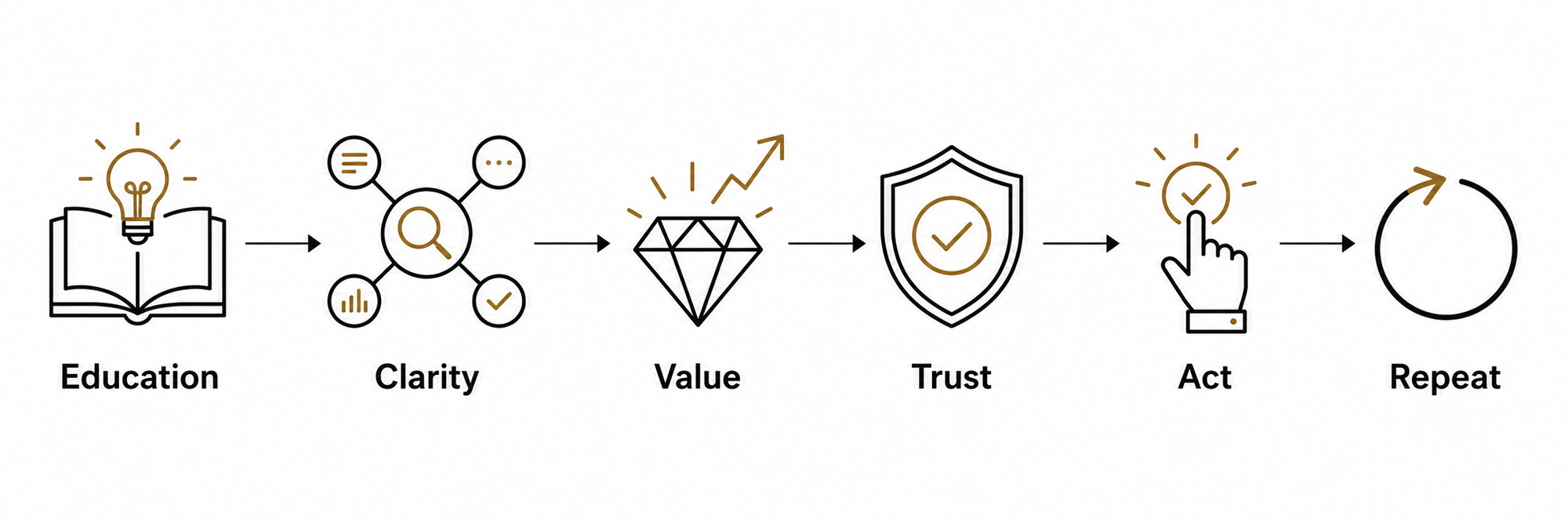
It looks clean on a whiteboard. In a wallet, every arrow can break.
A user may understand the product and see no relevant job. They may see the value and distrust the custody model. They may trust the company and still doubt their own ability to avoid a mistake. They may complete an onchain action and fail to find the asset. They may succeed once and never encounter a reason to return.
This is why objections should not automatically be diagnosed as knowledge deficits. Some are execution problems. Some are control preferences. Some are accessibility failures. Some are legitimate product-fit decisions. Some are rational refusals to accept a risk the product has not reduced or explained.
The wallet team's job is to identify which barrier exists at which moment—and avoid prescribing another article when the actual problem lives inside the product.
What wallet research shows when knowledge meets action
The most useful studies move past general awareness and examine what happens during wallet choice, setup, and authorization.
Accessible execution is part of usable security
A SOUPS 2023 study examined MetaMask and iteratively redesigned it as “iWallet” for blind users. Across several evaluations, the work involved 44 novice users, including sighted, blind, and low-vision participants. The redesign combined accessible explanations with better labels, explicit state feedback, address confirmation, and a revised recovery process. In the final evaluation, participants rated iWallet 81 on the System Usability Scale versus 70 for MetaMask (Zhou et al., 2023).
The point is larger than one accessibility cohort.
An explanation cannot guide action when the control is unlabeled, the state change is not announced, or the recovery step is too cumbersome to complete safely. In a wallet, accessibility, learnability, conversion, and security can fail through the same interface defect.
Wallet choice is contextual, not universal
Interviews with 24 cryptocurrency users found that people selected and secured wallets differently according to the job, value at risk, perceived threats, convenience needs, and preferred form of control. Browser, mobile, hardware, and smart-contract wallets were not interchangeable recommendations (Yu et al., 2024).
That means a generic “choose the safest wallet” lesson can be technically earnest and behaviorally weak. The product or recommendation has to fit the user's task and threat model. Education should clarify the trade-off; it should not pretend the trade-off disappears.
The authorization moment can outperform the passive warning
A 2026 USENIX Security study tested four in-wallet interventions for approval phishing with 364 participants, followed by 23 interviews. A spending-cap suggestion increased the likelihood of setting a cap. Active spender warnings and delayed confirmation significantly increased cancellation of phishing tasks; the increase for the passive warning was not statistically significant (Guan et al., 2026).
This is point-of-decision education.
The wallet did not merely tell users that token approvals can be dangerous. It helped them evaluate the parameter or consequence while they could still change the decision.
That is an important distinction for both growth and protection: the highest-leverage educational surface is often the moment when knowledge can still alter the action.
The pattern across the evidence: knowledge needs a delivery system
Across these studies, the same operating pattern keeps returning.
Awareness can improve openness, but intention is not the same as observed use. Education can change a mental model, but existing preferences about control and simplicity remain. Accessible explanation helps, but only when the controls and state changes are also usable. Wallet selection changes with the job and threat model. Security guidance becomes more effective when it arrives at the authorization moment and gives the user a meaningful way to respond.
That means the education-to-action system needs four things content alone cannot supply: a relevant job, an executable path, consequence-specific support, and behavioral proof. Remove any one of them and a team can report better understanding while activation remains flat.
Where the answer changes: wallet model, user job, and consequence
The evidence does not support one universal onboarding recipe.
A custodial wallet asks users to trust an institution's security, identity, access, withdrawal, and support systems. A self-custody wallet asks users to understand and manage a different share of recovery and authorization responsibility. A stablecoin recipient needs clarity about receiving and using value; a DeFi user may need to evaluate contract permissions; a payout user may care more about access, fees, and practical redemption than the underlying rail.
The intervention should also match the consequence. A low-risk read action does not need the same friction as a broad token approval. A familiar small transfer does not need the same reassurance as a new address, unusual network, high-value transaction, or recovery change.
The decision rule is simple: standardize the operating principle, then adapt the education, proof, defaults, and friction to the wallet model, user job, and value at risk.
Operating Model
The Understanding-to-Action Ladder
Education becomes adoption only when each learned concept survives the next product decision.
| Stage | What the wallet must provide | Evidence-aligned measure |
|---|---|---|
| Understand | Plain-language concepts and risks for the job at hand. | Objective comprehension. |
| See value | One relevant use case and a visible user benefit. | Qualified action intent. |
| Trust enough | Clear custody, reputation, service, risk, and control proof. | Correct setup start. |
| Feel capable | Accessible controls, progressive guidance, defaults, and state feedback. | Setup completion and time on task. |
| Act safely | Previews, confirmations, caps, simulation, active warning, or selective delay. | Safe first-value rate. |
| Repeat | Reliable service, clear records, support, and the next relevant money job. | Second- and third-action rates. |
| Recover | Tested backup, recovery, revocation, and verified support boundaries. | Recovery or revocation readiness. |
Interpretation note: This is a managerial synthesis of the cited research, not a statistical model validated by one paper.
The Understanding-to-Action Ladder
The process can be translated into a seven-stage operating model:
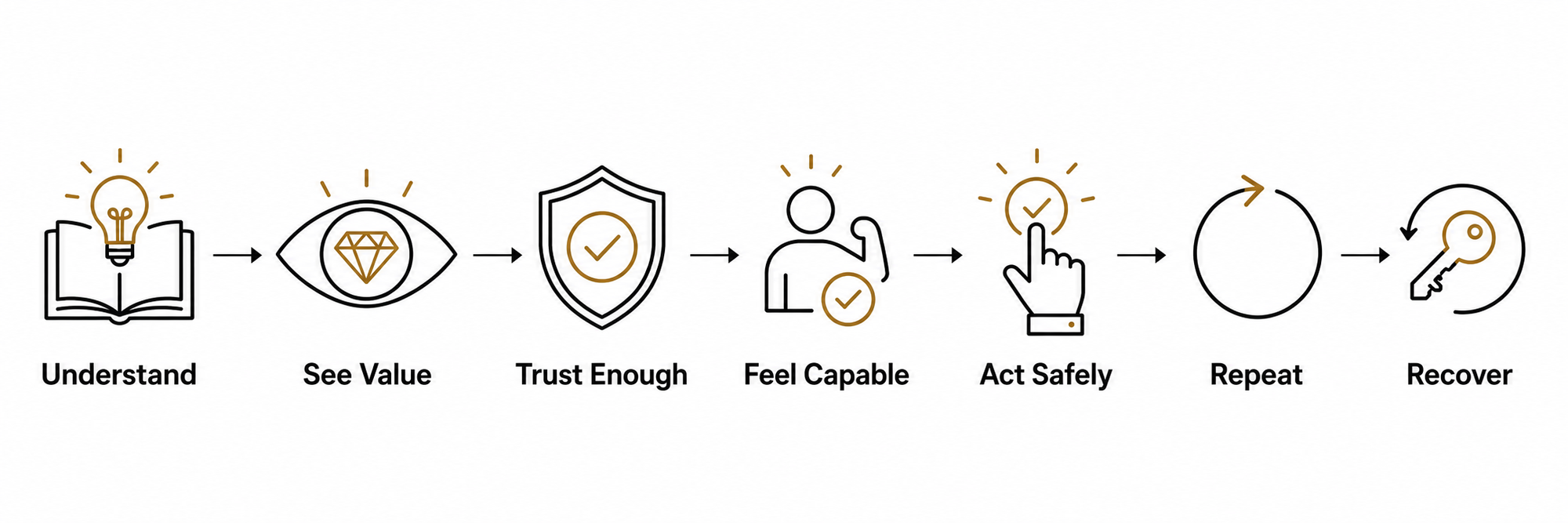
This is a managerial synthesis, not a statistical model validated by one study. Its purpose is to help marketing, product, security, analytics, support, and compliance locate the handoff they jointly own.
Understand: build the minimum correct mental model
The user does not need a blockchain degree. They need the concepts required for the job in front of them.
For a stablecoin recipient, that may mean understanding what was received, where it sits, what fees or restrictions apply, and how it can be used. For a self-custody user, it may mean understanding who controls access, what recovery can and cannot do, and what signing an approval permits.
The metric is objective comprehension of the relevant concept—not content exposure.
See value: connect knowledge to one real job
“Adopt crypto” is not a useful growth objective. Receive a payout, move funds to self-custody, connect to a vetted application, set a limited approval, or complete a cross-border transfer are useful adoption objects.
Education becomes motivating when the user can see why this knowledge helps complete a job they already care about. Without that relevance, a lesson can improve literacy while leaving behavior untouched.
Trust enough: make the route credible and controllable
Trust at this stage is specific. The user may need proof about the provider's reputation, custody architecture, support, fees, identity process, transaction simulation, recovery boundary, or control over permissions.
The product should answer the trust question attached to the next commitment—not hide every assurance in a general security center.
Feel capable: make safe completion realistic
This is where many teams misdiagnose anxiety as ignorance.
A user may know what an address is and still struggle to verify it. They may understand recovery and still face an inaccessible or cognitively heavy setup flow. Progressive guidance, labeled controls, sensible defaults, state feedback, and contextual help turn knowledge into capability.
Capability is visible in setup completion, error patterns, time on task, support demand, and accessibility parity.
Act safely: intervene at the consequence
The activation event should represent delivered value, not administrative progress. A generated address or connected wallet may be necessary, but it is not necessarily the outcome the user came for.
For many Web3 products, the first successful transaction as an activation metric becomes useful only when the transaction is technically successful, understandable to the user, relevant to the intended job, and cleaned for obvious error or abusive activity.
Transaction previews, address confirmation, approval caps, simulations, active warnings, and risk-triggered delays belong here. The goal is not maximal friction. It is friction proportional to consequence.
Repeat: prove that first value became utility
One successful action shows that the route can work. A second and third relevant action are stronger signals that the user found repeatable value.
Lifecycle communication should therefore attach to the next money job: the next payout, transfer, merchant use, permission review, or recurring action. This extends the broader idea of wallet confidence engineering by asking a narrower question: which learned behavior survived after the guided moment ended?
Recover: test resilience before an incident does
A user is not fully capable if access, revocation, or recovery remains theoretical.
The appropriate readiness check depends on the wallet model. It may involve confirming a backup, practicing an approved recovery flow, reviewing connected applications, revoking an unnecessary permission, or knowing where verified support begins and ends.
Recovery readiness is part of retained trust because the user is judging not only whether the normal flow works, but whether control survives when it does not.
The wallet interface is owned conversion media
Marketing teams often treat education as content they publish and the interface as a product surface they influence later. In a wallet, that separation is commercially expensive because the interface is where every educational claim is tested.
The interface is where the claim becomes evidence.
If a campaign promises control but the approval screen obscures scope, the product contradicts the positioning. If an academy explains recovery but setup encourages users to skip it without a credible return path, the workflow weakens the lesson. If a wallet promises simplicity but the confirmation state leaves the user unsure where the asset went, the transaction can be technically successful and behaviorally unresolved.
Product marketing should therefore co-own the language around custody, permissions, fees, recovery, success states, failure states, and the next relevant action. Security should shape the consequence model. Design should make the state perceivable. Analytics should instrument the handoff without collecting unnecessary identity or address-level data. Support should surface the recurring confusion that completion dashboards hide.
That is not marketing claiming every department's job. It is the organization accepting that a financial product communicates while it operates—and that this communication affects activation, safety, support burden, retention, and revenue.
What wallet teams usually get wrong
They measure the lesson instead of the transfer. Completion rates and quiz scores show that content reached the learner. They do not prove that the learner applied the concept in the product. The next event matters: did a qualified learner begin the correct flow, complete it, understand the result, and reach the intended value?
They educate for the category instead of the job. A general crypto curriculum can be useful for awareness, but the user authorizing a token approval needs a different explanation from the recipient trying to use a stablecoin payout. The better unit of education is the decision attached to a real task.
They rely on passive warnings. A generic risk banner may satisfy a communication requirement without helping the user evaluate the current action. Consequence-specific copy, parameter verification, caps, simulations, and selective delay are more actionable because they appear while the decision can still change.
They assume more action is always better. A higher transaction rate can conceal mis-sends, misunderstood permissions, unsafe speculation, or users pushed forward by incentives they do not understand. In financial products, prevented harm can be a successful outcome. Activation should represent informed first value, not irreversible clicking.
They separate the teams the user experiences as one product. The content may be accurate, the interface functional, the security control technically sound, and the support article complete. If those pieces disagree at the moment of action, the user experiences one confusing wallet—not four competent departments.
Measure adoption as observable progression
The scorecard should separate learning, capability, action, safety, repetition, and resilience. If all six are collapsed into one conversion rate, the team will not know whether it improved understanding, removed friction, encouraged a useful action, or simply persuaded more people to click through risk.
Objective comprehension rate is the share of users who pass a job-specific knowledge check after completing the relevant education. It verifies understanding, not adoption.
Learning-to-start rate is the share of qualified learners who begin the correct product flow. This tests whether the job and next step feel relevant enough to pursue.
Setup completion and time to first value reveal whether trust, usability, accessibility, or operational requirements block execution.
Safe first-value rate is the share of qualified setup completions that deliver the intended core outcome without a known execution error, mis-send, or security incident. No metric can certify that every transaction was wise or permanently safe. The purpose is more modest and more useful: stop counting obvious user failure as growth.
Protective-intervention success measures the share of relevant risk interventions that lead users to modify or cancel an unsafe action. This treats prevented harm as a product outcome rather than automatically classifying it as a lost conversion.
Second- and third-action rates distinguish guided trial from repeat utility. For payment use cases, recipient onboarding and payment network effects also matter because sender activation cannot compound when the recipient cannot confidently access or use the value.
Recovery or revocation readiness shows whether activated users can preserve control after the normal journey. Support contacts per 100 activated users and accessibility parity by step reveal confusion that aggregate completion rates can hide.
Finally, connect these measures to cost per activated user, support cost, retained transaction activity, fraud-adjusted lifetime value, and revenue or gross profit per active user where the business model permits. The goal is not a larger dashboard. It is a defensible bridge from education spend to user protection, retained utility, and business outcomes.
The evidence gives direction, not a universal recipe
Education still matters. Without a workable mental model, users are more likely to misunderstand value, custody, risk, or consequence. The argument is not “stop teaching.” It is “stop asking education to compensate for product conditions it cannot control.”
Friction also needs judgment. The 2026 approval-phishing study supports specific, risk-sensitive interventions; it does not justify making every wallet action slow or alarming. A low-risk read action and a broad token approval should not feel identical. Safety theatre can damage trust just as surely as an absent warning.
The custody model changes the design as well. Embedded or custodial flows may reduce early effort while increasing institutional, privacy, or data-governance dependencies. Self-custody preserves a different form of control while demanding more capability from the user. Marketing should explain the trade-off accurately rather than declaring one architecture universally superior.
It's important to note that the evidence presented here has limits because prototype and testnet behavior may differ when users risk their own funds.
That missing evidence is not permission to make a larger claim. It is the reason wallet teams should run privacy-conscious field tests against their own users, architecture, legal obligations, and business model.
Commercial bridge
For wallets, exchanges, protocols, and crypto fintech teams, the strategic question is no longer only, “How do we explain crypto more clearly?”
It is:
Where does correct understanding stop becoming correct action—and what must positioning, product, security, lifecycle communication, support, and analytics change at that exact handoff?
That is the level where education becomes an activation capability. It is also where senior Web3 growth marketing becomes commercially measurable: not more content for its own sake, but more qualified users reaching safe first value, repeating the core job, and creating healthier retention and economics.
Teams dealing with this gap can use a Web3 trust and activation review to identify where education, onboarding, usable security, lifecycle messaging, or measurement is preventing informed action.
Final takeaway
Crypto adoption is not simply a shortage of explanations.
Education creates a usable mental model. Relevance gives the user a reason to apply it. Trust makes the next step tolerable. Product design makes the action executable. Contextual intervention makes the decision safer. Confirmation makes the outcome understandable. Repetition and recovery show whether the capability endured.
The strongest growth claim is not:
“We educated more users.”
It is:
“We found where qualified users stalled, changed the experience at that point, increased safe first value and repeat utility, and measured the commercial and trust impact.”
Content teaches. The wallet transfers. Behavior proves what survived.
Frequently Asked
Questions
Is crypto education still necessary for wallet adoption?
Yes. Users need an accurate mental model of value, custody, fees, permissions, recovery, and risk. Education becomes effective when it is tied to a specific user job and reinforced by a product experience that makes the correct action understandable and executable.
Why does crypto education not guarantee wallet activation?
Understanding does not remove product friction, accessibility barriers, control preferences, trust concerns, or fear of irreversible mistakes. A user can pass a knowledge check and still abandon setup, misread an approval, fail to find the received asset, or see no reason to return.
What should count as crypto wallet adoption?
For growth measurement, adoption should normally require a safe, successful core action that delivers the expected value, followed by evidence of repeat utility. Wallet creation, connection, or stated intention are useful funnel signals but are not durable adoption on their own.
What is point-of-decision crypto education?
Point-of-decision education supplies the relevant explanation or control while the user can apply it. Examples include explaining approval scope before signing, confirming an address before sending, suggesting a spending cap, previewing transaction consequences, or clarifying recovery before setup is finalized.
Should crypto wallets add more friction for safety?
Only where the consequence or risk justifies it. Low-risk actions should remain efficient, while unfamiliar, high-value, abnormal, or broad-permission actions may warrant active warnings, additional verification, caps, simulation, or a short delay. The goal is adaptive friction, not universal friction.
How should wallet teams measure whether education changed behavior?
Connect objective comprehension to correct flow start, setup completion, time to first value, safe first-value success, response to risk interventions, second and third actions, support demand, and recovery or revocation readiness. Then relate those outcomes to retention and sustainable economics.
Does the model change for custodial and self-custody wallets?
Yes. Custodial wallets usually ask users to trust the provider's security, access, withdrawal, identity, and support systems. Self-custody wallets also ask users to manage recovery and authorization responsibility. Education, trust proof, defaults, and success measures should match the custody architecture.
Who owns the education-to-action system inside a wallet company?
No single function owns it alone. Marketing and product marketing define relevance and language; product and design make action usable; security shapes risk intervention; analytics measures progression; support exposes hidden confusion; and compliance or legal reviews claims, identity processes, disclosures, and experiment constraints.
Author bio
Stefan Furcoi is a senior Web3/Crypto growth marketer focused on wallets, exchanges, protocols, and crypto fintech. His work connects positioning, trust, compliant education, activation, retention, content authority, and measurable business outcomes.
For consulting, advisory, hiring, or collaboration inquiries related to wallet and crypto fintech growth, contact Stefan Furcoi.
Article Disclaimer
The content of this article is provided for general informational purposes only and does not constitute financial, investment, legal or tax advice. StefanFurcoi.com makes no representations or warranties regarding the accuracy or completeness of the information, and it should not be relied upon without consulting qualified professionals. Any views expressed are subject to change and do not reflect any commitment to update the information. You are solely responsible for your decisions and should conduct your own research before acting on any information.