Web3 Marketing Tools
Build a practical stack of Web3 marketing tools for research, content creation, automation and analytics. Learn how to match your toolkit to your team’s workflows and connect daily execution to measurable business goals.


A Web3 marketing team can accumulate AI subscriptions, automation builders, CRM records, dashboards, and video tools while still struggling to answer a basic question: which activity is creating a useful customer relationship? The value of the stack depends on the decisions it supports and the reliability of the connections between its parts.
Which tools belong in a Web3 marketing stack
A practical stack needs tools for research and drafting, an authoritative working record, task ownership, customer or account management, content production, and relevant measurement. Blockchain-facing teams may also need onchain queries, address research, and transaction inspection. The right combination depends on the product and team; this article assigns illustrative roles rather than ranking vendors or claiming that every tool is required.
Article brief
AI Marketing Workflows · Automation — a compact decision guide.
| Review | What to establish | Operating decision |
|---|---|---|
| Research | An answer tied to a retrievable source | Use AI assistance with evidence review. |
| Operations | A record with an owner and clear status | Choose an authoritative working system. |
| Automation | A defined trigger, check, and handoff | Handle stale data, failures, and duplicate runs. |
| Onchain analysis | A question with defensible data definitions | Keep addresses, labels, and people distinct. |
| Distribution | Approved content in the appropriate format | Preserve claim meaning across channels. |
| Commercial value | Useful decisions and maintained workflows | Evaluate the whole cost of the stack. |
Select tools around the decision and operating job, then verify that the connected workflow produces useful, reliable output.
Choose the operating job before the software
Suppose a wallet team wants a weekly view of whether a newly promoted workflow is being used again. It has a content calendar, a CRM, and a public dashboard. None of those tools automatically defines which activity matters, which addresses to include, or how the team should respond to a change.
The first job is to formulate the decision. Is the team evaluating a distribution partner, identifying a product issue, or deciding whether to repeat a campaign? Each may require different records and a different responsible person.
I would write that job in plain language before connecting anything: “Provide a reviewed weekly view of repeat use in the target workflow, with the data window, exclusions, and owner visible.” Once the job is clear, the team can choose the tools needed to perform it.
The research supports a layered view of automation
Parasuraman, Sheridan and Wickens’ model of human interaction with automation distinguishes information acquisition, analysis, decision selection, and action implementation. Different levels of automation can be assigned to each. This is a design framework, not validation of a named marketing integration; its useful implication is that retrieving data and acting on it need not receive the same delegation.
Brynjolfsson, Li and Raymond’s study of generative AI at work examines customer-support operations and reports heterogeneous effects across workers. It cautions against assuming one productivity benefit for every person and task. The study does not compare the marketing tools in this article.
Meiklejohn and colleagues’ Bitcoin measurement research uses heuristic clustering and external observations to study the actors behind address activity. Its methods are Bitcoin-specific. For a marketer, the inference is to document what an address or label represents rather than automatically treating each one as a distinct person or customer.
These papers inform the architecture and measurement choices below. Product documentation was checked separately for broad capabilities; vendor descriptions are not evidence of comparative effectiveness or marketing ROI.
Assign each tool a clear role
The following map uses tools relevant to Stefan Furcoi’s Web3 marketing workflow interests. It describes roles I would assign in a proposed system, rather than asserting a production deployment, vendor partnership, or measured result from using every product.
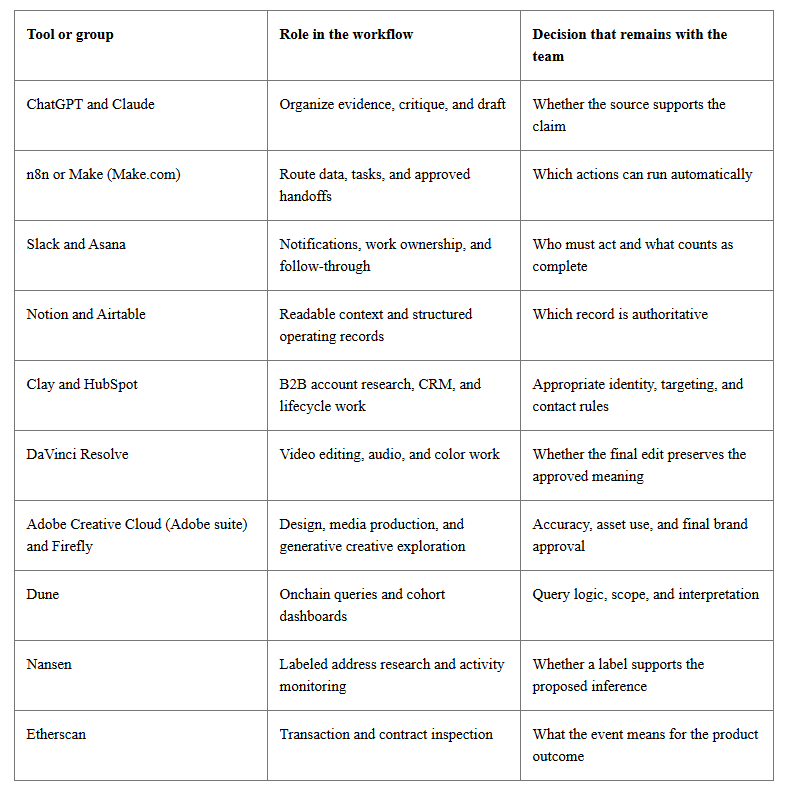
There is no benefit in using both members of every pair by default. A team can choose one orchestration tool or one primary editorial record when that meets the job. Additional software needs to justify the integration and maintenance it adds.
Keep a record that survives the conversation
Slack is useful for bringing an issue to someone’s attention. A conversation alone is a weak place to preserve the definition of a metric or the approval of a public claim. The decision should be captured in a record that the next person can find.
Asana can hold tasks and accountability. Airtable can hold structured campaign, claim, or measurement records. Notion can provide the brief, explanation, and decision history. The exact arrangement can vary, but the workflow should identify the authoritative location for each consequential item.
For a metric, preserve its definition, source, data window, owner, and version. For an asset, preserve the approved meaning, publication status, and dependencies. A connector should move or reference those records without creating untracked competing copies.
Onchain example one: a reviewed cohort report from Dune
Consider the wallet team’s repeat-use question. Dune can provide a query and dashboard layer for relevant onchain data. The team first specifies the contracts, events, time window, and unit of analysis. It identifies internal or test activity and explains what cannot be inferred from the available records.
An illustrative n8n or Make.com workflow could request the approved query result, check its freshness and completeness, and write a summary record. It would then notify the analyst or create an Asana review task. Only the reviewed interpretation would move into a public performance statement.
An empty result needs interpretation. It could mean no qualifying activity, a query problem, an unavailable source, or a mismatched time window. Converting every empty result to zero would make the automation appear decisive while hiding the failure.
Keep the query version and reporting window with the output. If the job reruns, it should update the intended report or recognize the existing result rather than create several contradictory alerts. The team needs to be able to reproduce the number used in a campaign review.
The interpretation also matters. A repeat address interaction may be useful evidence about a workflow, but it is not automatically a retained human customer. The measurement should connect to the product question without claiming an identity the data does not establish.
Onchain example two: use Nansen labels to form research questions
Labeled address research can help a team examine how activity is distributed or identify patterns worth investigating. Nansen provides a product context for this kind of research and monitoring. The labels should be interpreted using the provider’s definitions and the relevant data context.
For example, a growth analyst might investigate whether activity is concentrated around a small set of participants or whether a campaign coincides with a change in relevant fund flows. That observation could prompt a closer review of the cohort and product experience.
It should not automatically become a lead list, a claim about a person’s motives, or a public assertion that a named customer has adopted the product. An inferred category and a consented customer relationship are different records.
The useful automation is a research alert with a traceable basis. A person reviews the event, checks the definition, and decides whether a product or marketing investigation is warranted. This example concerns business analysis, not trading signals or investment recommendations.
Onchain example three: inspect a transaction with Etherscan
A campaign report says that users are encountering difficulty in a particular workflow. Before the marketing team rewrites the education, it may need to understand whether a transaction occurred, what contract was involved, and which stage of the product experience failed.
Etherscan offers transaction and contract data that can support this inspection. An analyst can use relevant hashes, logs, and supported data fields to investigate the chain-level event. That event should then be compared with the product’s own state and the user-facing experience.
The first successful transaction framework explains why a technical event and a delivered outcome need to be distinguished. Here, the tool’s job is to support the investigation, not decide which business metric the event should satisfy.
An automated task could attach the relevant inspection link to a product issue or research record. It should not turn the presence of a transaction into an unsupported statement that the customer received the promised value.
Connect CRM to a real customer relationship
Clay can support B2B account research and enrichment. HubSpot can provide a CRM and lifecycle operating layer. The useful question is which known account or appropriately linked customer relationship the team is trying to progress.
For an infrastructure business, a product-relevant account record can connect the research question, buying group, stage, and next action. For a consumer product, lifecycle work should use the first-party identity and permissions appropriate to the relationship. Public address activity does not by itself create permission to contact a person.
Keep the meaning of the event consistent when it reaches the CRM. A product evaluation, a live integration, and repeat user activity describe different stages. If all three become the same “converted” field, the automation loses the distinction the business needs.
Let creative tools serve the approved explanation
DaVinci Resolve can support video production, audio work, and color. Adobe Creative Cloud applications can support design and editing, while Firefly can help explore creative treatments. Choose the production arrangement around team competence, file handover, and the assets required.
The editorial record should follow the asset into production. A cut can remove a qualification; a caption can change a product term; a generated image can imply a real interface or endorsement that does not exist. Review the final artifact rather than assuming approval of the script covers every later representation.
The purpose is to preserve an accurate explanation through the production process. The studies cited here do not establish that one editor, image tool, or visual style produces better wallet growth.
Automate the handoff with an explicit failure path
A useful automation identifies the trigger, required input, checks, responsible recipient, and completion condition. It also explains what happens when a source is stale, a connector fails, an approval expires, or the same job runs twice.
- Start with a reviewed manual version of the operating job.
- Automate stable retrieval and routing steps with visible run status.
- Keep consequential interpretation and release decisions with an accountable owner.
- Review failures, duplicate actions, and maintenance effort before adding more volume.
Use the access required for the job. A marketing analysis workflow should not need custody secrets or transaction-signing authority to inspect public activity. Preserve the distinction between analyzing a system and controlling funds within it.
Select a minimum stack the team can maintain
A small team may need an assistant, an editorial record, a task system, an appropriate measurement source, and one production path before it needs extensive automation. A larger team may justify additional specialization and connectors.
Evaluate subscription costs alongside setup, review, failed runs, and maintenance. The cheapest tool on a pricing page can be expensive if the team cannot operate it reliably. A more capable product can also be unnecessary when the job is simple.
For optional industry topic discovery, the supplied Messari research URL currently redirects to Blockworks Intel’s research page. Treat this permitted practitioner resource as context, separate from the peer-reviewed evidence supporting the article’s research claims.
My focus in a Web3 growth and operations review is the decision the stack enables. The best next tool is the one that fills a defined operating gap without making the evidence, owner, or customer outcome harder to understand.
Frequently Asked
Questions
What are the most useful Web3 marketing tools?
Useful categories include research assistance, operating records, task ownership, CRM, production, and measurement. Blockchain-facing teams may also need onchain queries, labeled address research, and transaction inspection. Choose the products around the job and team rather than treating a long tool list as a strategy.
Should I use n8n or Make for marketing automation?
Compare them against the specific workflow, required integrations, permissions, deployment preferences, and the team’s ability to maintain it. Test a bounded job first. This article does not rank their performance or assume that a particular connector or feature is available in every plan.
How can Dune help a Web3 marketing team?
Dune can provide a query and dashboard layer for relevant onchain activity. The team still needs to define the cohort, events, exclusions, time window, and interpretation. Keep the query version and data freshness with any result used in a growth decision.
What is the difference between Nansen and Etherscan in this workflow?
The proposed Nansen role is labeled address research and activity monitoring. The proposed Etherscan role is inspecting transactions, contracts, and related chain data. Neither role automatically identifies a customer or establishes that a product delivered its intended outcome.
Should onchain activity automatically create CRM leads?
Public activity alone does not establish a consented customer relationship or a reliable personal identity. Use appropriate first-party identity and permissions for CRM and lifecycle work. Treat inferred labels as research inputs that require interpretation.
Can marketing automation publish performance claims automatically?
Only after the team has deliberately assigned and validated that responsibility. A safer starting design routes data and drafts for accountable review, preserving source, window, and version. A successful connector run does not establish that the interpretation is fit to publish.
How do you evaluate the cost of a Web3 tool stack?
Include subscriptions, setup, review effort, integration failures, and maintenance. Compare the complete operating job with the manual alternative and the value of the decision it supports. More automation is useful only when the team can still understand and maintain the workflow.
About the author
Stefan Furcoi is a senior Web3/Crypto growth marketer focused on wallets, exchanges, protocols, and crypto fintech. His work connects positioning, trust, compliant education, activation, retention, content authority, and measurable business outcomes.
Article Disclaimer
The content of this article is provided for general informational purposes only and does not constitute financial, investment, legal or tax advice. StefanFurcoi.com makes no representations or warranties regarding the accuracy or completeness of the information, and it should not be relied upon without consulting qualified professionals. Any views expressed are subject to change and do not reflect any commitment to update the information. You are solely responsible for your decisions and should conduct your own research before acting on any information.