How to Market a Crypto Wallet Without Sounding Like Hype
Help users understand what your crypto wallet does and why it matters. Explore messaging built around practical benefits, credible evidence and clear expectations, with a focus on trust, onboarding and lasting adoption.


A wallet campaign becomes easier to judge when it gives the reader something specific to inspect. Who controls access? What does a supported transfer look like? Which costs can the user see before confirming? Those questions lead to useful content because the product team can verify the answer and the audience can connect it to a real decision.
How do you market a crypto wallet without hype
Explain one useful workflow for a defined audience, substantiate the important claims, and preserve the product’s responsibilities and limits. Build a shared evidence brief before adapting the message into articles, LinkedIn posts, or YouTube videos. Measure whether the content helps relevant people understand and progress, alongside the reach it receives.
Article brief
AI Marketing Workflows · Content Systems — a compact decision guide.
| Review | What to establish | Operating decision |
|---|---|---|
| Promise | One specific outcome for a defined reader | Write a claim the product team can verify. |
| Proof | A demonstration or scoped supporting record | Make the evidence easy to inspect. |
| Language | Concrete actions and visible limits | Replace broad adjectives with useful information. |
| A relevant professional question and next step | Review audience and response quality. | |
| YouTube | A clear explanation supported by the actual workflow | Measure attention without equating it with adoption. |
| Maintenance | A shared claim record across published assets | Update the source and affected derivatives. |
Build content around a verifiable wallet promise, then preserve its scope through every format and update.
The content problem is often an undefined promise
Consider a hypothetical wallet preparing a campaign around convenience. The first draft describes a seamless, secure experience for everyone. The words sound familiar because they leave the difficult questions unanswered. Convenient for which task? Under what configuration? With which responsibilities left to the user?
The editorial job is to make the promise specific enough that a reader can evaluate it. Removing enthusiastic adjectives is only part of that work. The team needs a meaningful product claim, evidence that supports it, and an explanation that survives a change of format.
This article focuses on that content system. The market and channel choices belong in the broader GTM plan. Here, the question is how to turn a verified product fact into a useful public asset without expanding its meaning along the way.
Begin with the expectations the content creates
Voskobojnikov and colleagues’ research on mobile wallet experience identifies reported usability problems and misconceptions in historical app reviews. The implication for content is to investigate the expectations a message creates.
A wallet explanation should help the reader understand the task and the relevant responsibility. A recovery article should reflect the supported recovery arrangement. A fee explanation should distinguish the costs that apply to the described workflow. A demonstration should make its configuration visible.
These details belong in the central content brief, where the product owner can verify them. If they appear only in a final disclaimer while the main message implies something broader, the content has not solved the reader’s question.
Build the Wallet Evidence Brief
The Wallet Evidence Brief is a proposed editorial tool that connects the reader’s question with the claim, proof, necessary limitation, and next action. It is not an academically validated marketing formula. Its purpose is to make the important decisions explicit before the team produces several versions of the message.
For each asset, specify the audience’s existing context. A technically experienced user and a first-time user may need different explanations of the same feature. Then identify the one decision the content should help that person make.
Record the exact claim and the evidence that supports it. Identify which product version or configuration the evidence covers, who can review it, and what would make the claim need an update. Finally, define the useful next step: a relevant product explanation, a demonstration, or a supported action.
The brief gives writers, designers, and video editors a shared reference. They can change the presentation while preserving what the company is entitled to say about the product.
Use concrete language the reader can picture
Packard and Berger’s research on concrete language and customer satisfaction finds benefits from specific language in customer-service interactions across several studies. It is not a test of crypto advertising. My application is to make wallet content describe observable actions rather than rely on broad assurances, then test the result with the intended audience.
The following are illustrative editorial directions, not approved claims for an actual wallet. Any revised wording still needs evidence from the product being marketed.
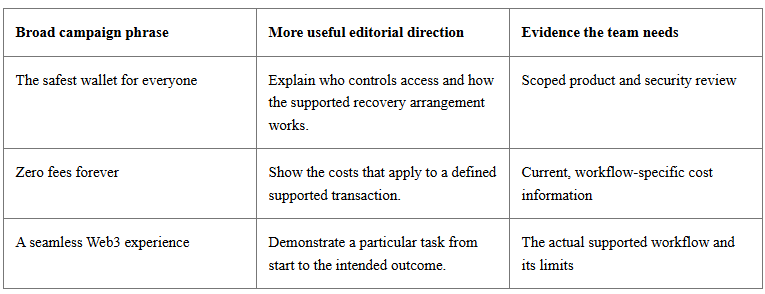
Specificity does not mean placing every technical detail in the headline. The headline should set an accurate expectation; the content should answer the question it raises. Link to the evidence where additional depth is useful.
This approach complements crypto education that supports action. The content should make the next step understandable while preserving the facts the user needs to decide whether it is appropriate.
Make the owned article the detailed explanation
A long-form article can hold the context that short formats cannot. Give it one primary question, a clear answer near the beginning, and a logical sequence that helps the reader evaluate the product issue. Use a brief table and FAQ when they reduce the work needed to understand the answer.
Hollebeek and Macky’s conceptual research on digital content marketing describes content’s role in engagement, trust, and value. It supports thinking beyond an immediate purchase message. This brings the focus on more sustainable long-term building over instant hype.
For the wallet team, the owned explanation should be the place where important qualifications remain visible and can be maintained. It can support a social post, a sales conversation, or a tutorial without requiring the reader to reconstruct the product story from several fragments.
Search optimization should preserve that clarity. Use a descriptive title, useful headings, relevant internal links, and source anchors that support the claim. Avoid creating several articles that answer the same question with slightly different keyword phrases. Each page should have a distinct job in the authority hub.
Use LinkedIn to explain a professional question
LinkedIn can serve founders, product leaders, partners, and other professional audiences when the content begins with a decision they recognize. A wallet team might explain a custody responsibility, a product tradeoff, or a lesson from a verified workflow demonstration.
The post needs enough context to stand on its own. It should also give an interested reader an appropriate route to the fuller explanation. A compressed version should not convert a conditional feature into a universal promise simply because the shorter statement sounds stronger.
Use native personal-post analytics to inspect the response to an individual’s content, and LinkedIn Page analytics for the company Page. These are different reporting contexts. Compare relevant response quality and available audience information alongside the headline engagement counts.
For an editorial review, examine whether the people responding resemble the intended audience and whether their questions reveal better understanding or unresolved confusion. A small number of relevant questions can justify a useful follow-up asset. It is not automatically a measure of product demand.
Newsletter and article formats can support deeper explanations where appropriate, with the relevant native reporting. The team should choose the format because it serves the question, rather than assume that one format guarantees distribution.
Use YouTube to show what the wallet claim means
Video gives the team an opportunity to demonstrate a supported task, explain a decision, or make a responsibility easier to understand. The sequence should show the actual configuration and the outcome being discussed. Avoid editing the demonstration into a cleaner promise than the product can deliver.
Guo, Kim and Rubin’s study of educational video engagement analyzes edX viewing sessions and finds differences associated with production choices and video length. It does not establish a universal YouTube duration rule or show that watching a crypto tutorial causes adoption. Its useful application is to test focused explanations and observe where the audience loses the thread.
YouTube Studio can help the team examine impressions, click-through behavior, watch time, and audience retention. A retention dip is a question to investigate. It may reflect a mismatch, an unnecessary introduction, a confusing passage, or another factor; the chart alone does not identify the cause.
TubeBuddy and vidIQ can be optional tools for topic, keyword, and packaging exploration. Their suggestions should be treated as inputs to editorial decisions. A tool score does not establish that a title is accurate or that the topic will attract qualified wallet users.
DaVinci Resolve or an appropriate Adobe production tool can support the edit. Check captions, on-screen terms, cuts, and the final thumbnail against the evidence brief. Each can alter the meaning the viewer receives, even when the original script was approved.
Build one content package around a narrow wallet question
Suppose the hypothetical wallet team wants to explain the responsibilities involved in a supported recovery arrangement. The product owner first verifies the configuration and the boundaries of the explanation.
The owned article can provide the detailed account. A LinkedIn post can explain one relevant decision for a professional audience. A focused YouTube segment can demonstrate the supported sequence. A longer conversation can explore tradeoffs when the subject requires more context.
These assets should share the claim record rather than become independent improvisations. The short post may link to the full explanation, while the video description can direct a viewer to the maintained product information. The wording can vary; the responsibility should remain consistent.
- Agree on the reader’s question and the supported product claim.
- Verify the evidence and the limitation that must survive adaptation.
- Produce the owned explanation and channel-specific assets.
- Review the final text, visuals, captions, and next step before release.
- Record the assets that need review when the product or evidence changes.
This is a proposed content operating process. Its value should be evaluated through the team’s review effort, content quality, and the outcomes relevant to the intended audience.
Measure the content at the level of the question
Reach matters when the job is to reach the right people. It becomes less informative when the team cannot connect the audience to the product question or the next step. Keep awareness measures alongside evidence of understanding and progression.
For LinkedIn, review relevant interaction and the subsequent route to the owned explanation where observable. For YouTube, review whether viewers reach the important part of the demonstration and whether the title sets an accurate expectation. For the article, examine qualified navigation and the questions readers still ask.
When linking content to product use, preserve the distinction between association and causation. People who choose to watch a tutorial may already be more motivated. A credible comparison can help investigate the content’s incremental contribution; a view-to-action sequence alone does not prove it.
The existing activation measurement article addresses the product outcome. This content system adds another question: did the public explanation set the expectation that the product actually fulfilled?
Preserve an identifiable brand while listening to users
User stories, questions, and creator contributions can improve the editorial agenda. The company should still maintain an authoritative account of its product responsibilities, supported features, and current limits.
Before republishing a testimonial or creator explanation, review what it implies about the product. A compelling personal experience does not establish the same result for every user. Keep the original context and ensure the company’s own explanation remains easy to find.
Too much qualification can make content difficult to read. Solve that by choosing a narrower promise and presenting the detail in the right place. The team does not need to place a technical manual inside every post. It needs the post to remain accurate at the level of meaning it communicates.
Make the content system a source of product clarity
My approach to wallet content connects the public promise, the available proof, the format, and the user’s next decision. A Web3 Trust and Activation Audit can help a team identify where its messaging and content journey leave those elements disconnected.
A credible wallet campaign gives people a useful way to understand the product. The evidence brief makes that explanation repeatable across channels without asking the audience to accept a larger claim than the company can support.
Frequently Asked
Questions
How can a crypto wallet avoid hype in its marketing?
Choose a specific reader and useful workflow, make the product claim concrete, and provide supporting evidence with its important limits. Preserve that meaning across the article, social post, video, and next step rather than relying on broad adjectives to create confidence.
Can wallet marketing say the product is completely safe?
A broad safety assurance needs a basis and scope that a simple campaign phrase rarely explains. Have the appropriate product and security reviewers verify the claim. A narrower explanation of a supported control or responsibility can give the audience more useful information.
How should wallet teams use LinkedIn?
Explain a professional question relevant to the intended audience and provide an appropriate route to the fuller evidence. Use native post and Page analytics in their proper contexts, then review response quality and relevant progression alongside engagement counts.
How should wallet teams use YouTube?
Demonstrate supported workflows and explain the decisions or responsibilities involved. Review the final script, edit, captions, and thumbnail for accuracy. Use YouTube Studio to investigate attention and audience response without equating a video view with product understanding or adoption.
Which LinkedIn and YouTube tools are useful?
Begin with LinkedIn’s native personal-post and Page analytics and YouTube Studio’s impressions and retention reports. TubeBuddy or vidIQ can support optional topic and packaging research. Select tools for a defined job and verify current access rather than treating scores as a performance guarantee.
What is a Wallet Evidence Brief?
It is the proposed editorial record linking a reader’s question to a product claim, supporting proof, necessary limitation, owner, and next action. It helps maintain consistent meaning across formats and identify which published assets need review after a product change.
About the author
Stefan Furcoi is a senior Web3/Crypto growth marketer focused on wallets, exchanges, protocols, and crypto fintech. His work connects positioning, trust, compliant education, activation, retention, content authority, and measurable business outcomes.
Article Disclaimer
The content of this article is provided for general informational purposes only and does not constitute financial, investment, legal or tax advice. StefanFurcoi.com makes no representations or warranties regarding the accuracy or completeness of the information, and it should not be relied upon without consulting qualified professionals. Any views expressed are subject to change and do not reflect any commitment to update the information. You are solely responsible for your decisions and should conduct your own research before acting on any information.